Skip to content
Keffiyeh vs Shemagh: What's the Difference & Which Is Yours?
- by furqan wear
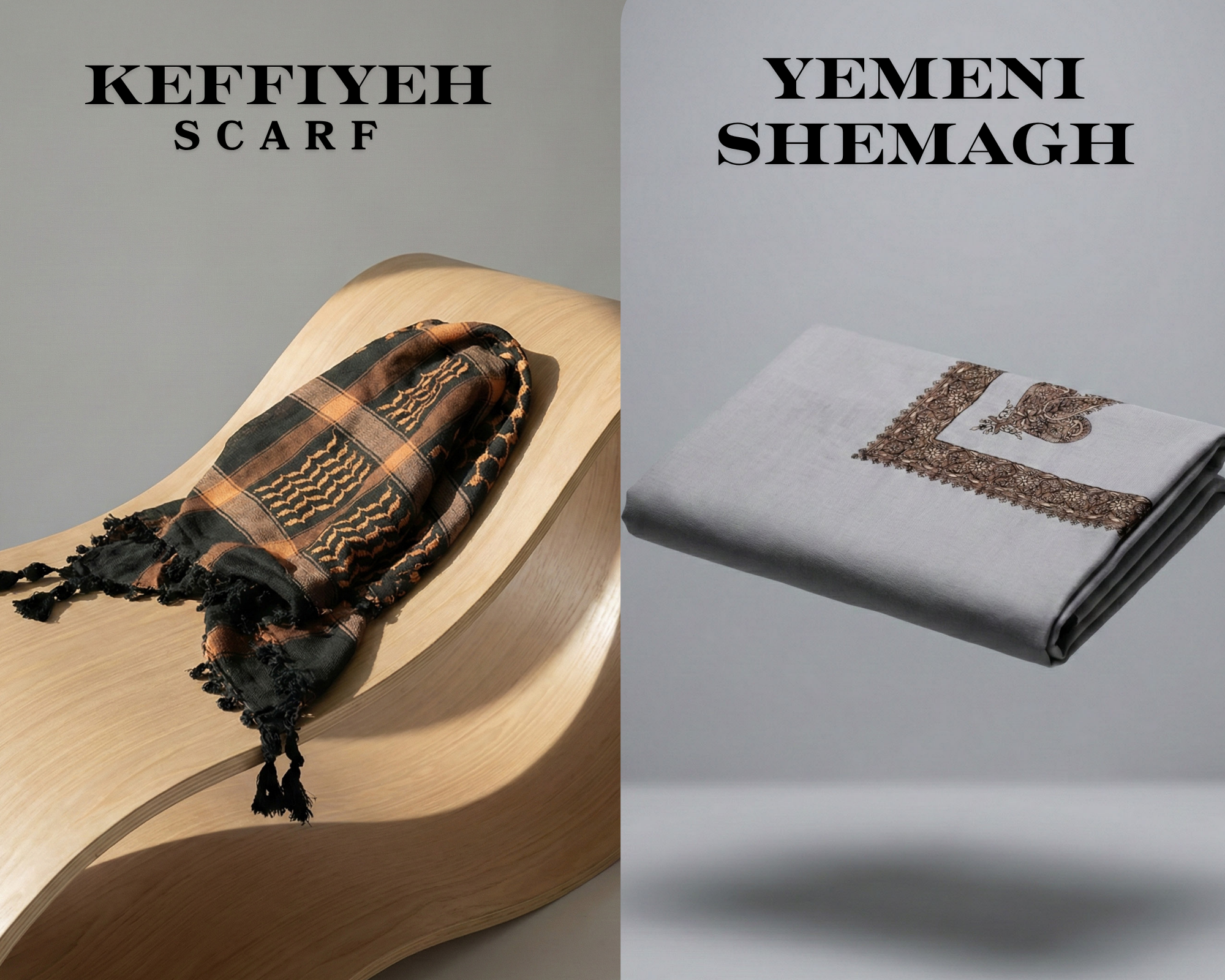
Keffiyeh vs Shemagh
A keffiyeh is a lightweight 49" x 49" cotton scarf rooted in Palestinian and Levantine identity.
A shemagh is larger at 60" x 60" with a heavier weave, rooted in Bedouin and Gulf heritage. Both are the same garment — different regions, different names, different cultural weight.
You've seen it your whole life.
On your father's shoulders. On the men outside the masjid. On screens, on streets, in protests, in prayers. A square of cloth that carries more weight than most things in this world.
But here's where brothers get stuck — is it a keffiyeh or a shemagh? Are they the same thing? Which one do I actually wear? What does each one mean?
These are the right questions. And they deserve a real answer — not a five-second Google result.
This guide covers the full history of both, the real differences in size, fabric, and pattern, which one is right for you, how to wear it, and where to find one that's actually worth owning. By the end, you'll know exactly which one is yours.
They're Not Two Different Things — They're One Story
Let's start with the most common misconception.
Keffiyehs and shemagh are not another kind of clothing. They are identical square cloths — same weave of cotton, same knotted tassels by hand, same cut as a shawl. What differentiates them is geography, history and the communities that wore them.
Keffiyeh — also spelled as kufiya, kufiyah and kaffiyeh – is from the Levant. Palestine, Jordan, Syria. Shemagh is an Islamic headwear which has origins from the Arabian Peninsula and Gulf region (Saudi Arabia, Iraq, Yemen & Kuwait).
Same cloth. Different names. Different patterns. Different weight of meaning.
This is not fashion history. This is the history of Muslim and Arab men marking their presence in the world — generation after generation — with a piece of cloth. And that history is worth knowing before you put one on.
The Keffiyeh — What It Carries
The keffiyeh goes back over 3,000 years.
Farmers in ancient Mesopotamia — the land between the Tigris and
Euphrates River — wore it in the fields to protect against the sun. Fishermen wore it by the Mediterranean. [Historians trace the keffiyeh back to the priests and farmers of ancient Mesopotamia]— a practical cloth worn for survival, not symbolism. It was a tool before it was a symbol. Practical. Necessary. Unremarkable — until history made it remarkable.
That changed in 1936.
During the [Arab Revolt of 1936] against British occupation in Palestine, leaders made a deliberate decision — they called on every Palestinian man to wear the keffiyeh. Not just the rural poor who already wore it, but the educated, the urban, the elite. In 1938, the leadership of the revolt formally ordered that urban men replace their tarbush hats with the keffiyeh — to create unity, and to allow rebels to blend in when they entered the cities. It became the cloth of solidarity. One people. One cloth. One refusal to disappear.
Then came Yasser Arafat.
He wore the black-and-white keffiyeh every single day of his public life — styled and draped in a specific way, folded to trace the shape of the map of Palestine. He wore it to the United Nations. He wore it in negotiations. He wore it until he died. That image went around the world. The keffiyeh became a symbol that needed no translation.
Today, when a brother in Toronto or London or Sydney drapes a black and white keffiyeh over his shoulders, he is not making a fashion statement. He is not wearing a trend. He is continuing something that has survived colonisation, occupation, exile, and erasure.
That is what it carries.
The pattern is not random. The tight fishnet weave represents the sea — the Mediterranean that Palestinian fishermen worked for centuries. The olive leaves woven through represent the land. The two things Palestine is named for. Every thread has a reason.
The white keffiyeh carries a different kind of history. White was worn by Palestinian leaders and men of spiritual standing, closest to the fitrah, the natural state of the believer. It is understated. It is clean. It says everything without trying to. The red keffiyeh comes from Bedouin roots in Jordan and the Hejaz. The red-and-white pattern — sometimes called the shemagh in Jordan — is the national dress of Jordanian men. It carries the weight of the desert, of tribal honor, of men who built identity in places with nothing but sky and stone.
The Shemagh — What It Carries
The shemagh belongs to the desert.
Bedouin tribes across the Arabian Peninsula wore it not as a symbol, but as survival. It protected against the sun in summer, the cold in winter, and the sandstorms in between. It covered the face. It wrapped the neck. It was a tool, the way a good knife is a tool — essential, trusted, never decorative.
The Prophet Muhammad ﷺ is reported to have worn a head covering similar in nature to the shemagh — making this not just culture, but something closer to sunnah. For the Muslim man, that is not a small detail.
Over centuries, the shemagh became embedded in the identity of entire nations. The red-and-white pattern became the national dress of Saudi Arabia and Jordan. Yemeni tribes developed their own patterns — intricate, bold, tribal — heavier cloth, tighter weave, built for the mountains. The Yemeni shemagh is its own thing entirely. Not Jordanian, not Gulf, not Palestinian. Distinctly Yemeni.
The Yemeni shemagh is the largest and heaviest of the collection — 60 x 60 inches, woven with the bold geometric patterns that come out of Yemen's tribal tradition. If you want full head coverage, all-season durability, and something that commands presence the moment you put it on — this is it.
The shemagh does not carry the same political history as the keffiyeh. But it carries something else — the dignity of men who survived hard land and harsh sky and still held their heads up. Who built civilization in the desert? Who protected their families with nothing but faith and determination.
That is not a small thing either.
The Ghutra — The Third Cloth You Should Know
If the keffiyeh is the cloth of the Levant and the shemagh is the cloth of the desert, the ghutra is the cloth of the Gulf.
It is the same square of cotton, but plain white. No pattern, no check, no fishnet weave. Just clean, white fabric, draped over the head and held in place with a black agal cord. You've seen it on every Saudi, Emirati, and Qatari leader who has ever appeared on a world stage. The all-white headscarf against the thobe. Understated. Authoritative. Unmistakable.
Size, Fabric & Pattern: The Real Differences
Here is where the practical difference lives. Because knowing the history matters — but so does knowing what you're actually buying.
| Keffiyeh | Shemagh | Ghutra | |
|---|---|---|---|
| Pattern | Checked — fishnet + olive | Bold geometric, tribal | Plain white — no pattern |
| Color | Black & white, red, white, watermelon | Red & white, solid black | White only |
| Region | Palestine, Jordan, Syria | Saudi Arabia, Iraq, Yemen | Saudi Arabia, UAE, Qatar, Kuwait |
| Size | 49" × 49" | 60" × 60" | 47"–55" (varies by region) |
| Worn with | Thobe, casual wear, shoulder drape | Full head wrap, cold weather | Agal (black cord), formal Gulf dress |
| Cultural weight | Palestinian identity, Arab resistance | Bedouin heritage, Gulf pride | Gulf formal dress, Islamic statesmanship |
The shemagh is 11 inches wider on all sides. That matters. The extra size is what makes full head coverage possible — the traditional Gulf wrap, the Shaykh-style drape, the full face cover in cold weather. You cannot do that properly with a 49" cloth.
The keffiyeh's lighter weight is what makes it ideal for everyday wear — thrown over the shoulders on a Friday, wrapped at the neck over a thobe, draped casually over a hoodie. It sits lightly. It doesn't bulk.
Both are cotton. Both have hand-knotted tassels on all four corners. Neither should ever be synthetic. If you pick up a keffiyeh and it feels like plastic — put it down. The real thing is cotton; it breathes, and it gets better with every wash.
The Colors and What They Mean
The keffiyeh is not just black and white. Each color carries its own story.
Black & White: The original Palestinian keffiyeh. The most recognized pattern in the world. Olive branches and fishing nets woven in black on white cotton. If you wear one keffiyeh in your life, this is the one.
White: Worn by spiritual leaders and men of standing. The color of the fitrah. Clean and powerful in its simplicity.
Red: Bedouin heritage. Jordanian identity. Bold and grounded. Worn with intention, not decoration.
Watermelon: Four colors: red, white, black, green. The colors of the Palestinian flag — woven into a single cloth. This is not subtle. It is not meant to be.
Black & Gold / Black & Golden Yellow: Colors rooted in Abbasid Caliphate heritage. Rich, warm, unmistakable. The gold thread catches light in a way that makes people stop.
Olive: The color of the land. Quiet, earthy, dignified.
Solid Black Shemagh: No pattern. No color. Just black cotton at 60 x 60 inches. The one that goes with everything and says everything.
Which One Is Right for You?
This comes down to two things — how you wear it and what you want it to do.
Choose the Keffiyeh if:
-
You want something lightweight for daily wear
-
You drape it over your shoulders or wrap it at the neck
-
You're drawn to Palestinian patterns — black and white, red, white, watermelon
-
You wear it with a thobe, hoodie, or everyday Western clothes
-
You want to start simple — the black and white keffiyeh is where most brothers start
Want to go deeper on the keffiyeh before deciding? Read the full Keffiyeh Scarf Guide.
Choose the Shemagh if:
-
You want full head coverage — traditional wrap or Shaykh style
-
You live somewhere cold — Canada, UK, northern US — and need all-season coverage
-
You want the Yemeni pattern or the solid black
-
You want something that doubles as a prayer cover, travel wrap, or full shoulder piece
If you want the boldest, most complete piece in the collection, read the Premium Yemeni Shemagh Guide before deciding.
Can't decide?
Most brothers end up with both. The keffiyeh for everyday. The shemagh for Jumu'ah, for winter, for the moments that call for more.
That is not excess. That is knowing what you wear and why.
How to Wear It — 4 Ways
There is no single correct way to wear a keffiyeh or shemagh. What matters is that you wear it intentionally — not as a costume, not as a prop, but as a brother who knows what he's putting on.
1. The Shoulder Drape
Fold in half diagonally into a triangle. Drape over both shoulders with the long folded edge at the front and the point hanging at the back. This is the most common way brothers in the West wear it — over a thobe, over a jacket, over a hoodie. It is effortless and it reads immediately.
2. The Neck Wrap
Fold into a long rectangle — about 8 inches wide. Wrap once around the neck, let both ends fall forward or tuck them in. Clean, everyday, works with anything. The lightweight keffiyeh is perfect for this.
3. The Traditional Head Wrap
Fold diagonally into a large triangle. Place on the head with the fold at the forehead. Let both ends fall to the sides or drape one end over the opposite shoulder. The shemagh is better for this — the 60" size gives you the coverage and drape the keffiyeh can't.
4. The Shaykh Drape
Place the shemagh flat on the head. Let both sides fall evenly over the shoulders. Secure with an agal (black cord) or tuck the front edge. This is how it is worn as formal dress across the Gulf. The Yemeni shemagh is built for this. Practice once in front of a mirror. After that, it becomes natural.
A Note on Wearing It in Public
Some brothers hesitate. You know what I mean.
You're in a Western city — Toronto, Chicago, Sydney, London — and there's a part of you that wonders what people will think, whether it's too visible. Whether it will make things harder.
That hesitation is real. And it deserves to be named.
But here is what is also real: you were not asked to apologize for what you are. Allah honored the children of Adam — every single one of them. That honor does not come and go based on what is convenient for the people around you.
The brother who wears his keffiyeh to the grocery store is not asking for trouble. He is not making a political statement. He is a man who knows where he comes from and is not embarrassed by it. That is a different thing entirely.
Wear yours with intention. Not defiance. Not performance. Just the quiet confidence of a man who knows exactly who he is.
What to Look for When Buying
Most of what you'll find online is wrong before you even open the package.
Synthetic polyester passed off as cotton. Printed patterns that crack and fade after two washes. Undersized at 44" or 45" — not a traditional size. Dropshipped from a marketplace warehouse that no one has inspected.
Here is what to check before buying any keffiyeh or shemagh:
-
Full traditional size: 49" x 49" for keffiyeh, 60" x 60" for shemagh. Anything smaller is cut short.
-
Cotton: not polyester, not a synthetic blend. Cotton breathes. Polyester suffocates.
-
Hand-knotted tassels on all four corners: not sewn, not glued, not cut fringe. Knotted.
-
Owned inventory: the brand holds and inspects its stock before shipping. Not a marketplace reseller.
For the full breakdown on how to spot a fake and where brothers in Canada and the USA are buying with confidence, read → Where to Buy an Authentic Keffiyeh Online
Where to Buy a Keffiyeh or Shemagh Online
Furqanwear carries a full collection of premium keffiyeh scarves and shemagh for men — all cotton, all full traditional size, all hand-knotted tassels.
-
Black Keffiyeh Scarf: The original. 49" x 49". The most recognized keffiyeh pattern in the world.
-
White Keffiyeh Scarf: The color worn closest to the fitrah. Clean, quiet, powerful.
-
Red Keffiyeh Scarf: Bedouin heritage. Solid red pattern, worn with intention.
-
Yemeni Shemagh: 60" x 60". Intricate Yemeni tribal weave. Built for full coverage and every season.
-
Chocolate & Cream Keffiyeh Scarf: warm, earthy tones, grounded and unmistakable.
-
Obsidian & Gold Keffiyeh Scarf: deep black and gold, rooted in Islamic heritage
-
Black & Scarlet Keffiyeh Scarf: volcanic black with vivid scarlet woven through.
-
Slate & Silver Keffiyeh Scarf: cool grey and silver thread, understated and certain.
Furqanwear is a Canadian Muslim brand — owned inventory, inspected before every shipment, not dropshipped. Shipped to Canada, the USA, Australia, and New Zealand. All taxes included at checkout — no duties, no surprises.