Skip to content
What Is an Omani Thobe? The Dishdasha and Its Signature Furakha
- by Mahidur Furqan
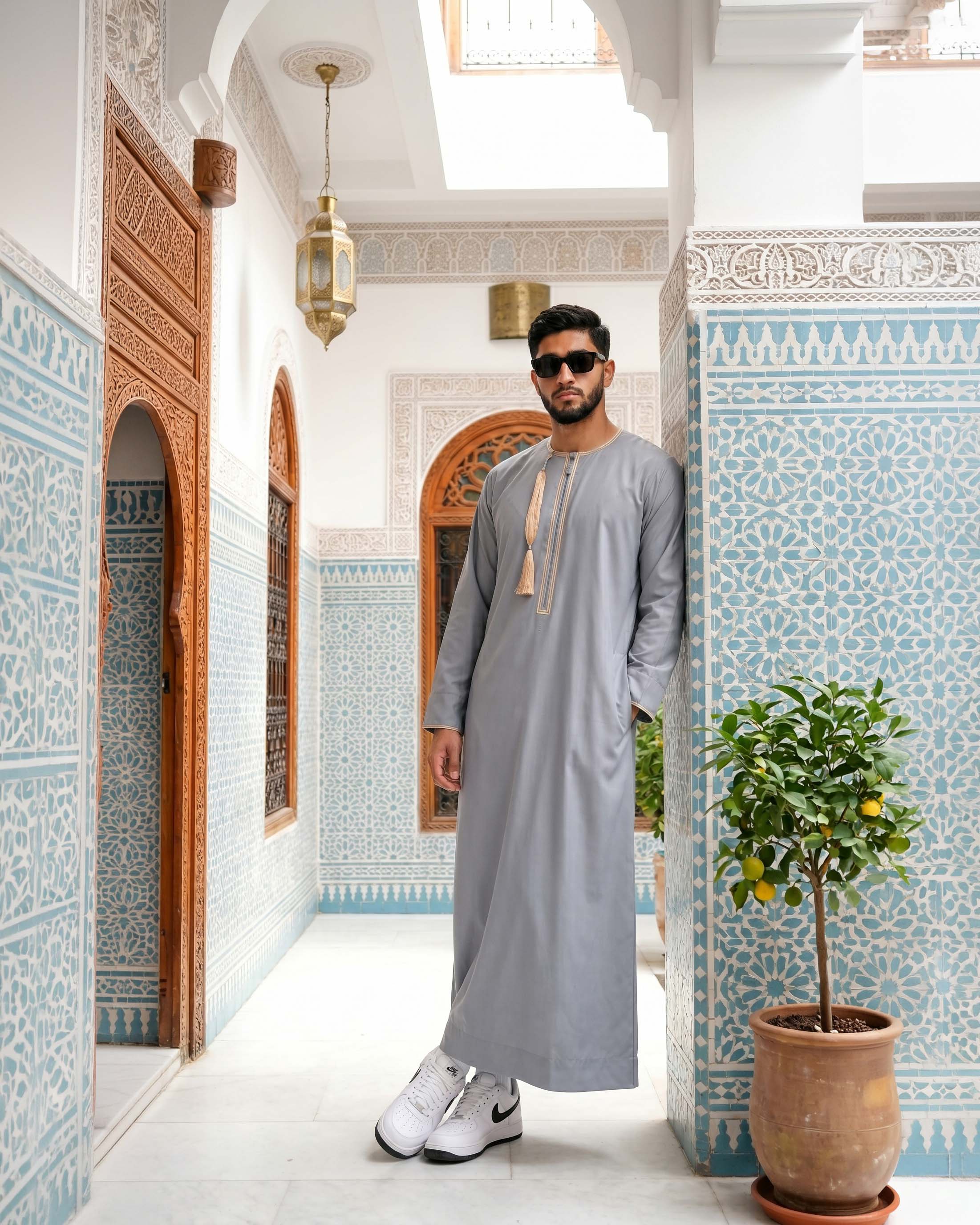
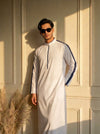
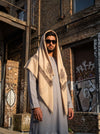
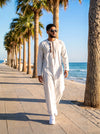
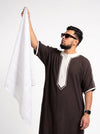
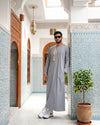
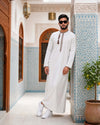
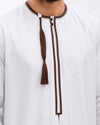
An Omani thobe, also called a dishdasha, is a traditional Gulf men's garment with a collarless, rounded neckline and a signature tassel known as the furakha at the neck, cut in a relaxed straight silhouette. It is the softest and most comfortable of the Gulf thobe styles, worn from daily prayer to Eid.
If you have ever seen a man in a clean white robe with a small tassel resting at his collarbone and wondered what it was called, this is it. The Omani thobe is one of the most recognisable garments in the Muslim world, and also one of the most misunderstood — because it goes by several names, shares a family with thobes from other Gulf regions, and carries small details most people never learn to read.
This guide walks you through all of it. What the garment is, what that tassel means, how it differs from the Saudi and Emirati styles you have probably also seen, what colours it comes in, and when a brother actually reaches for it. By the end, you will know more about the Omani thobe than most people who sell it. You can see the full range any time in our Omani thobe collection.
What is an Omani thobe?
The Omani thobe is the everyday robe of Oman — a long, ankle-length garment with long sleeves, a clean collarless neckline, and a relaxed, straight cut that drapes without clinging. What sets it apart from the robes of neighbouring regions is the neckline: where a Saudi thobe has a structured, buttoned collar, the Omani version stays open and soft, finished with a single tassel that hangs from the throat.
That softness is the whole point. The Omani cut is built for ease. There is no stiff collar to sit against your neck through a long khutbah, no tight fit to fight against when you move from standing to ruku to sujood. It is the thobe you can wear from Fajr to the last gathering of the night and forget you have it on. For a man who wears his garment all day, every day, that comfort is not a small thing.
The name itself tells part of the story. In Oman, the garment is most often called a dishdasha. Travel to the UAE and you will hear kandura. In parts of South Asia, a similar robe is called a jubba. Same core garment, different regional word — which is exactly why so many people end up confused.
What is the furakha?
The furakha is the tassel that hangs from the neckline of the Omani thobe — and it is the single detail that tells anyone who knows what they are looking at.
It is a small, twisted cord, usually a few inches long, stitched at the throat so it falls down the centre of the chest. Far from being mere decoration, it carries a quiet tradition: the furakha is often scented, dipped in oud, musk, or attar, so that a man carries his fragrance with him through the day. A subtle thing. A dignified one.
This is also where the Omani thobe is most often confused with the Emirati kandura. Both have a tassel, but they are not the same tassel, and they are not called by the same name. The Omani tassel is the furakha, set at the neckline. The Emirati version is the tarboosh, which hangs lower from the chest. To the untrained eye, they look alike. To anyone raised around these garments, the difference is immediate.
When you understand the furakha, you understand the Omani thobe. It is the garment's signature, and naming it correctly is part of wearing it with knowledge rather than just wearing it.
Is an Omani thobe the same as a dishdasha or kandura?
Yes, for the most part, these are different regional names for the same family of garments, with small variations in cut and detail.
The broad term is thobe (also spelled thawb). According to the encyclopedic record on the thobe and its regional names, the same ankle-length robe is called a dishdasha in Oman, Kuwait, Iraq, and the Levant, a kandura in the UAE, and a jubba across much of South Asia. So when you search "omani thobe," "omani dishdasha," or "omani jubba," you are very often looking for the same thing.
Where the small differences live is in the details. The Omani dishdasha keeps its collarless neckline and its furakha tassel. The Saudi thobe adds a structured collar. The Emirati kandura is minimalist and clean, with the tarboosh on the chest. None of these are strict rules — they are regional expressions shaped by climate, culture, and identity over centuries. If you want the wider picture of what a thobe is and how the regional styles relate, that guide covers the whole family. But knowing the names lets you search with intention and buy with confidence, instead of guessing.
What's the difference between an Omani, Saudi and Emirati thobe?

Each Gulf thobe carries its own signature. Here is how the main styles compare at a glance:
|
Style |
Region |
Signature feature |
Best for |
|
Omani (dishdasha) |
Oman |
Collarless rounded neckline + furakha tassel (often scented) |
Relaxed, comfortable all-day wear |
|
Saudi (thobe) |
Saudi Arabia |
Structured, buttoned shirt-style collar |
Formal occasions, a sharp presence |
|
Emirati (kandura) |
UAE |
Collarless and minimal, with a tarboosh tassel on the chest |
Clean, understated daily wear |
|
Moroccan (djellaba) |
Morocco / North Africa |
Full hood, often heavier fabric |
Cooler weather, cultural gatherings |
If you want the most formal and structured look, the Saudi thobe is your style. If you prefer something sleek and minimal, look at the Emirati thobe. If you want a hood and a heavier drape for the cold, the Moroccan djellaba is built for it. But if you want the easiest, softest, most comfortable thobe to wear from morning to night, the Omani is the one.
What colours does an Omani thobe come in?

Traditionally, the Omani thobe is worn in white — but it is also worn in deeper and warmer tones, each carrying its own feeling. At Furqanwear, we carry four:
-
White. The classic. White is the Sunnah colour, and it has always been the Muslim man's first choice for Jummah, for Eid, and for everyday wear. The Prophet ﷺ said, "Wear white clothes, for they are the best of your clothes," as recorded in the Book of Dress in Riyad as-Salihin. Clean, dignified, and never out of place. See the white Omani thobe.
-
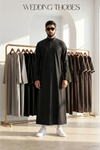
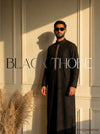
Black. Quiet strength. Black is the understated choice — presence without announcement, a thobe that lets the man speak rather than the garment. See the black Omani thobe.
-
Dove Grey. A soft, modern grey for the man who wants distinction that is still fully traditional. See the dove grey Omani thobe.
-
Peach Cream. Warmth, and a little arrival. The colour for Eid mornings, when every other man wears white and you want to stand within tradition while standing out a little. See the peach cream Omani thobe.
White remains the most versatile — it works for everything, every day. But the deeper colours give a man room to dress for the moment rather than the default.
When do you wear an Omani thobe?
The honest answer is: whenever you want to carry yourself with intention. But a few moments call for it especially.
For Jummah. The walk to the masjid on Friday is one of the small dignities of the week. A clean white Omani thobe, simple sandals, a kufi — it is the most Sunnah-aligned thing a brother can wear through those doors, and the collarless comfort means you can sit through the khutbah without a single distraction.
For Eid. Eid morning carries a weight you have felt since childhood. The smell of attar, the early walk before sunrise, the gathering of the whole community in their best. The Omani thobe was made for that morning — and the warmer colours, like peach cream, let you mark the day as something apart from the ordinary week.
For a Nikah. Whether you are the groom or a guest, a wedding is a moment to dress with dignity. The clean lines of the Omani cut carry well in photographs and across a long evening of sitting, standing, and greeting.
For everyday. And then there are the ordinary days — work, errands, dinner, the school run. This is where the Omani thobe quietly earns its place. It needs nothing. It asks nothing. It simply lets you live your faith in plain sight, without fuss.
How do you care for an Omani thobe?
A traditional cotton thobe is beautiful, but it comes with the iron. The wrinkles set in, the upkeep adds up, and the garment that was meant to make life simpler becomes one more thing to manage.
Our Omani thobes are made from 100% spun polyester for exactly this reason. They are wrinkle-free from the moment you take them off the hanger to the moment you fold them at night, machine washable on a standard cycle, and built for a man who prays five times a day and lives a full life in between. No dry cleaner. No ironing board. No fuss.
Care is simple: wash with like colours, cool or warm water, and hang dry or tumble dry on low. For whites, keep them with whites to hold their brightness. That is the whole routine. The Sunnah never needed an iron and neither does this.
Why buy your Omani thobe from a Canadian brand?
Most thobes sold to brothers in North America ship from overseas, which means long waits, customs surprises at the border, and sizing cut for a different build. We started Furqanwear to close that gap.
We are based in Toronto, Ontario. We own our inventory and check our own quality, so the thobe you order is the thobe we have held. We ship across Canada and the USA, with duties included to the States — no surprise fees waiting for you at the border — and our thobes are sized XS to 3XL for North American builds, with a size guide on every product page. You can browse our full men's thobe collection or the wider range of Islamic clothing for men whenever you are ready.
You were never meant to shrink to fit in. The right thobe is not about asking for acceptance — it is about claiming what is already yours. Allah ﷻ honoured all the children of Adam. Dress like a man who knows it.