Passer au contenu
What Is a Djellaba? Meaning, Origin and How to Wear It
- par Mahidur Furqan
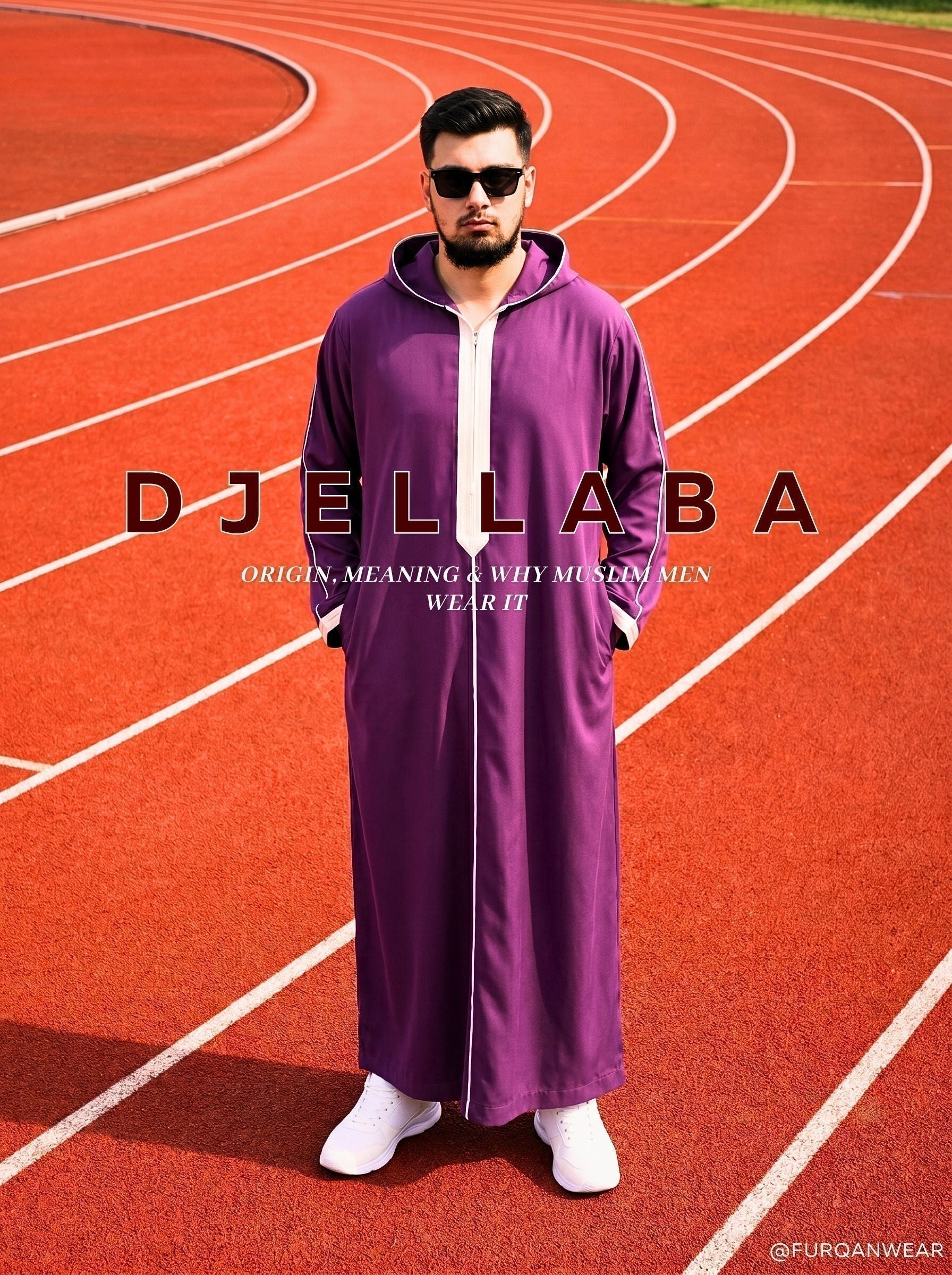
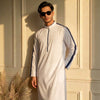
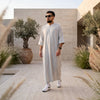
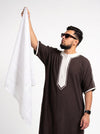
A djellaba is a long, loose-fitting hooded robe traditionally worn by men across Morocco and the wider Maghreb. Its defining feature is the qob — a pointed hood that once shielded the wearer from sun, wind and sand. It is also spelled jellaba, djelaba, or jalaba.
That's the short answer. The long one is far more interesting.
The djellaba carries a thousand years of meaning in a single silhouette. It's a garment shaped by the Atlas Mountains, refined by Maghrebi craftsmen, and worn today by Muslim men from Casablanca to Toronto to New York. For some men, it's daily wear. For others, it comes out only for Jummah, Eid, and weddings. Either way, putting on a djellaba is never a small thing. The garment carries presence. The man inside it does too.
This is the complete guide to what a djellaba is, where it came from, what makes it different from other Islamic garments, and how to wear it well — whether you're new to traditional Islamic menswear or you've worn one your whole life.
How Do You Pronounce "Djellaba"?
The standard pronunciation is ji-LAH-bah — phonetically written as /dʒɪˈlɑːbə/.
The stress falls on the middle syllable. The "dj" at the start sounds like the "j" in "jam." The "ll" is a clean L sound, not doubled. The final "a" is soft — closer to "uh" than to a hard "ah."
If you've heard it pronounced differently, you're not wrong. The djellaba has been adopted across many languages, and small pronunciation differences are normal between Moroccan Arabic, Algerian Arabic, French, English, and Berber speakers.
It's also spelled in several ways across the English-speaking world:
-
djellaba (the most common spelling in English)
-
jellaba (anglicized variant)
-
djelaba (shortened spelling)
-
jalaba (regional variant)
-
djellabah (variant ending)
-
jellabiya (closer to the original Arabic jallābīya)
-
gallabea (less common, North African variant)
The spelling differences come from how Arabic and Berber sounds get romanized into Latin letters. None of them is wrong. If you see a brand or article using one of these alternates, it's still the same garment.
The Meaning and Etymology of Djellaba
The word djellaba traces back to the Arabic root جلب (jalaba), meaning "to bring, attract, fetch, or import."
From that root comes jallāb, an Arabic word meaning "trader" or "importer." And from that comes jallāba (a variant of jallābīya) — which originally referred to a "garment worn by traders." The djellaba, then, started as the garment of moving men. Traders crossing North Africa. Merchants traveling between cities. Men who needed clothing that could carry them through long, unpredictable days.
In Tamazight — the Berber language of the indigenous Imazighen people of North Africa — the djellaba is sometimes called tadjellabit. The word reflects the garment's deep roots in Berber culture, long before Arabic became the dominant language of the region.
So when you put on a djellaba, you're putting on a name that means something that travels with you. It was never meant to be a costume folded in a closet for Eid alone. It was meant to be worn. Often.
A Brief History of the Djellaba
The djellaba is older than most people realize. Its origins trace back to Imazighen — the indigenous Berber peoples of North Africa of Morocco and across the Maghreb long before the Arab conquests of the 7th century. Berber craftsmen developed the long hooded robe as practical clothing for life in the mountains and the desert: warmth in cold weather, protection from sun and wind in hot weather, and a single garment that could carry a man through changing climates without needing to be removed.
The hood — the qob — was functional from day one. A shepherd in the High Atlas, a trader crossing the Sahara, a farmer in the Rif Mountains: all of them needed something that could be pulled up to shield the face and the head when conditions demanded it. The djellaba's silhouette was shaped by that need.
When Islam spread through the Maghreb in the 7th and 8th centuries, the djellaba was already established. It was adopted into Islamic culture without resistance because it already aligned with Islamic principles of modest dress — loose, covering, dignified. Muslim men in the Maghreb wore it for daily life, for prayer, for ceremony.
For centuries afterward, the djellaba developed regional variations. Different cities became known for different fabrics, embroidery, and silhouettes. The Moroccan city of Bhalil, in the Fes-Meknes region, became famous for its handmade buttons that closed the front of traditional djellabas — buttons that took hours to make and were prized across the country.
During the French protectorate of Morocco (1912–1956), the djellaba took on a new role. Moroccan women, who had not traditionally worn the djellaba in public, began wearing it as an elaborate symbol of cultural identity and resistance to French colonial influence. The garment became more than clothing — it became a way of saying we are still who we are.
Historically, the color of a man's djellaba could communicate his status. In some regions, a dark brown djellaba signaled that the wearer was an unmarried man, while specific patterns and trims marked married men, scholars, or those of certain professions. These conventions have softened in modern times, but the garment still carries quiet signals if you know how to read them.
Today, the djellaba is worn across the world — by Moroccan men in their hometowns, by Maghrebi diaspora communities in France, Spain, Belgium, and the Netherlands, and increasingly by Western Muslim men who are reclaiming traditional Islamic menswear as part of their daily lives. The history of the djellaba is the history of Muslim men carrying their identity with them, wherever they went.
The Qob — The Hood That Defines a Djellaba
If you removed the hood from a djellaba, it would no longer be a djellaba. The qob (Arabic: قب) — the pointed hood at the back of the garment is the single feature that defines it.
The qob is more than a design element. It's the practical and cultural anchor of the djellaba. Functionally, it served the original wearers as protection from the elements: the burning sun of the southern Moroccan plains, the bitter cold winds of the Atlas Mountains, the sandstorms that swept across desert trade routes. A traveler could pull the qob up over his head and continue walking without breaking stride.
Symbolically, the qob carries something quieter. It frames the head. It gives the silhouette its identity. When a man pulls the qob up, he isn't disappearing — he's marking himself. Even with the hood down resting on the shoulders, the qob's pointed shape is what tells the eye this is a djellaba, not a thobe, not a kaftan.
In modern Western contexts, the qob also serves as a head covering for prayer when one isn't wearing a kufi or other prayer cap. A Muslim man preparing for salah can pull up the hood and continue without needing a separate garment.
The qob is what makes the djellaba unmistakable.
Traditional Djellaba Fabric: Wool, Cotton and Modern Microfiber
For most of its history, the djellaba was made from one of two fabrics: wool for winter, cotton for summer.
Wool djellabas — sometimes called sof djellabas in Morocco — were the traditional choice for cold weather. Heavy, hand-woven, often in natural undyed shades of brown, grey, or black, they carried the warmth a man needed in the mountains and during the cooler months in the cities. Berber weavers in the Atlas Mountains were known for producing some of the finest wool djellabas in North Africa.
Cotton djellabas were the summer counterpart — lighter, more breathable, easier to wash, and worn in warmer months and in the southern parts of the Maghreb where temperatures could climb. White and pale neutral colors dominated cotton djellabas because they reflected heat.
In more recent decades, linen has also appeared as a warm-weather alternative, valued for its breathability and natural texture.
Modern Islamic menswear has added a new category: microfiber blends. A typical microfiber djellaba uses a polyester-spandex blend (commonly 90% polyester, 10% spandex) that delivers benefits traditional fabrics couldn't:
-
A fluid, draping silhouette that holds its shape
-
Resistance to creasing and wrinkling through long days of wear
-
Easier washing and care
-
A consistent finish across multiple garments
-
Year-round wearability in mild and warm climates
At Furqanwear, our djellabas are made from a premium microfiber blend (90% polyester, 10% spandex) sourced from Dubai. The result is a garment that carries the traditional silhouette and presence of a djellaba while suiting the daily life of a Muslim man living in Canada, the United States, or anywhere in the modern world. You can browse all our djellaba fabrics and colorways to see how the modern interpretation compares to the traditional cut.
Regional Variations and Alternative Spellings
The djellaba isn't a single fixed garment. Across the Maghreb, regional differences shape how it's cut, what it's called, and how it's worn.
In Morocco — the country most associated with the djellaba — the garment is part of everyday menswear. You see it in the medinas of Marrakech, Fes, Casablanca, and Tangier. It's worn by older men daily, by younger men for Jummah and Eid, and across all classes from farmers to professionals.
In Algeria, the djellaba exists alongside a related garment sometimes called the qeššaba — similar in concept but with different regional cuts and traditions.
In Tunisia, the djellaba is less common in daily wear but still recognized as part of the regional Islamic menswear vocabulary.
Among Berber communities, especially in the High Atlas Mountains around Imilchil, the djellaba carries strong cultural significance. Tamazight — the Berber language of the Imazighen in place of the Arabic djellaba.
The alternative spellings you'll see online — jellaba, djelaba, jellabiya, jalaba, djellabah, gallabea — all refer to the same garment family. Some come from different transliterations of the Arabic, some are regional pronunciations, and some are simply common misspellings that have stuck.
If you're searching for a djellaba online and one spelling doesn't return results, try another.
Djellaba vs Thobe — The Short Version
The djellaba and the thobe are often confused, especially by Western Muslim men who are new to traditional Islamic menswear. They are not the same garment.
The djellaba is North African — Maghrebi in origin. Its defining feature is the qob (the hood). The cut is generally looser and more relaxed. Sleeve openings tend to be wider. The garment carries a softer, more flowing silhouette.
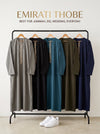
The thobe is from the Arabian Peninsula — Gulf in origin. It does not have a hood. The cut is typically straight, ankle-length, and more tailored. Sub-regional variations include the Saudi thobe, Emirati thobe, Omani thobe, and Bahraini thobe — each with distinctive collars, cuffs, and tailoring details. The Moroccan thobe sits between the two traditions: Maghrebi in origin like the djellaba, but cut without the qob.
When to wear which? The djellaba leans toward Maghrebi heritage and Jummah/Eid/wedding occasions in Western contexts. The thobe leans toward Gulf heritage and everyday wear for many men, with some regional thobes (like the Saudi white thobe) being almost universally recognized as formal Islamic attire.
Many Muslim men own both. The djellaba and the thobe aren't competing — they're two different expressions of Islamic menswear, each with its own tradition and its own occasion.
For the complete comparison — including which is better for different climates, prayer settings, and Western daily life — read our full guide on thobe vs djellaba differences.
Who Wears the Djellaba Today?
The djellaba is worn by Muslim men across the world, but the contexts have evolved.
In Morocco and across the Maghreb, the djellaba remains part of daily life for many men, especially older generations and in smaller cities and rural areas. In urban Casablanca, Rabat, and Marrakech, you'll see it on Fridays for Jummah, during Ramadan evenings, on Eid days, and at family gatherings. Younger Moroccan men often wear it for ceremony rather than every day, but it remains a baseline garment in every man's wardrobe.
In the Maghrebi diaspora — Moroccan diaspora across Europe and North America, and increasingly in Canada and the United States — the djellaba is worn by men who want to maintain a visible connection to their heritage. For a Moroccan-Canadian man in Toronto, putting on a djellaba on Eid day isn't just clothing — it's continuity.
Among Western Muslim men more broadly, the djellaba has been quietly reclaimed in recent years. Brothers from non-Maghrebi backgrounds — Pakistani, Bangladeshi, Egyptian, Somali, African American — are wearing djellabas for Jummah, Ramadan, weddings, and formal Islamic gatherings. The garment isn't ethnically locked. It's a Muslim man's garment, and any Muslim man can wear it with confidence.
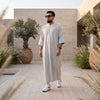
A man in a djellaba carries something the modern world tends to strip away — presence, gravity, the visible claim of identity in public. When you walk into a masjid in a djellaba, you're saying I'm here, I'm Muslim, and I'm not asking permission to be either. When you walk down a street in a djellaba in the West, you're saying the same thing. That visibility is a choice and increasingly, more brothers are making it. Worn today from Jummah to a walk through the city, the hooded djellabas for men carry that same dignity into modern life.
How to Wear a Djellaba
The djellaba is a wardrobe, not a costume. Worn with confidence, it carries weight. Here are the basics:
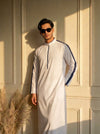
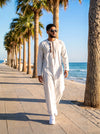
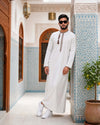
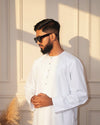
For Jummah and daily prayer, a white or light-toned djellaba (white, light khaki, slate blue) paired with a kufi is the classic combination. Clean, considered, calm.
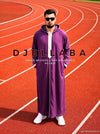
For Eid and formal celebrations, the djellaba is your moment to carry a deeper color — burgundy, deep purple, dusty rose, emerald green, silver. Pair with simple leather sandals or loafers. A folded Yemeni shemagh or Keffiyeh around the shoulders adds an extra layer of dignity for the ceremony.
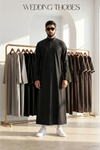
For weddings especially nikah and walima — the djellaba reads beautifully in dusty rose, silver, deep purple, or wooden brown. Choose colors that complement the venue and the celebration without competing with the groom or close family.
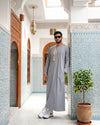
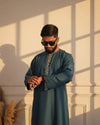
For everyday Western wear, the wooden brown, light khaki, or slate blue djellabas work as understated daily garments. Worn over a fitted underlayer, with simple shoes, the djellaba becomes a comfortable, dignified piece you can wear to the masjid, to family gatherings, or just around the neighborhood.
Hood up or down? Context. Hood down is the default — relaxed, conversational. Hood up adds gravity — useful in cold weather, during prayer if you don't have a kufi, or in moments when you want to draw inward and focus.
Where to Buy a Djellaba

For most of the last century, finding a quality djellaba in North America has been hard. The garment was either imported in small batches by family members traveling back from Morocco, found in scattered ethnic clothing shops, or ordered through overseas websites with long shipping times, inconsistent quality, and customs fees that surprised you at the door.
That gap is what Furqanwear was built to close.
Furqanwear is a Toronto-based premium Islamic menswear brand. We own our inventory, control our quality, and ship duties-included to both Canada and the United States. When you order a djellaba from us, what you see at checkout is what you pay — no surprise customs fees, no waiting weeks, no inconsistent sizing.
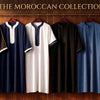
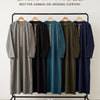
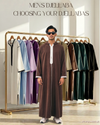
Our men's djellaba collection features ten colorways, each cut from the same premium microfiber blend (90% polyester, 10% spandex), each finished with the traditional qob hood, each available in sizes XS to 3XL (up to 4XL on the djellaba).
-
For Jummah and clean structure: Djellaba White
-
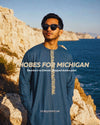
For everyday wear: Djellaba Slate Blue or Djellaba Light Khaki
-
For ceremony and weddings: Djellaba Burgundy, Djellaba Dusty Rose, Djellaba Silver
-
For autumn and winter: Djellaba Wooden Brown
-
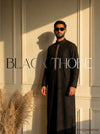
For bold presence: Djellaba Deep Purple, Djellaba Emerald Green, Djellaba Black
Free shipping on orders over $100 CAD to Canada and the USA. Taxes and duties are included at checkout. 14-day returns in plain English, no runaround.
Caring for Your Djellaba
A djellaba is meant to be worn often. Care for it accordingly:
-
Wash in cold water on a gentle cycle with similar colors.
-
Avoid bleach, harsh detergents, and high heat.
-
Dry on a low tumble setting or air dry to maintain shape and color.
-
Iron on a cool setting if needed — high heat affects the spandex in microfiber blends.
-
Store hanging on a sturdy hanger rather than folded. This keeps the silhouette clean and the qob from creasing.
-
Hand wash any embroidered or detailed djellabas to preserve the work.
Show Up With Honor
The djellaba was made for the man who knew who he was.
Centuries of Maghrebi craftsmen. Generations of Muslim men who walked through their lives with the garment on their shoulders — not folded away for special occasions, but worn as part of who they were. The hood pulled up against the desert wind. The robe was pulled over the head before standing in prayer. Worn often. Worn well.
Today, the djellaba is still here. The man who chooses to wear one in Toronto, in New York, in Houston, in Calgary, in Sydney — that man is continuing something. Not performing identity. Just being it.
Shop the Furqanwear djellaba. Premium microfiber blend. Ten colorways. sizes XS to 3XL (up to 4XL on the djellaba). Free shipping on orders over $100 CAD to Canada and the USA. Taxes and duties included. Show up with honor.