Passer au contenu
The Sunnah of Dress for Men: How the Prophet ﷺ Taught Us to Dress
- par Mahidur Furqan
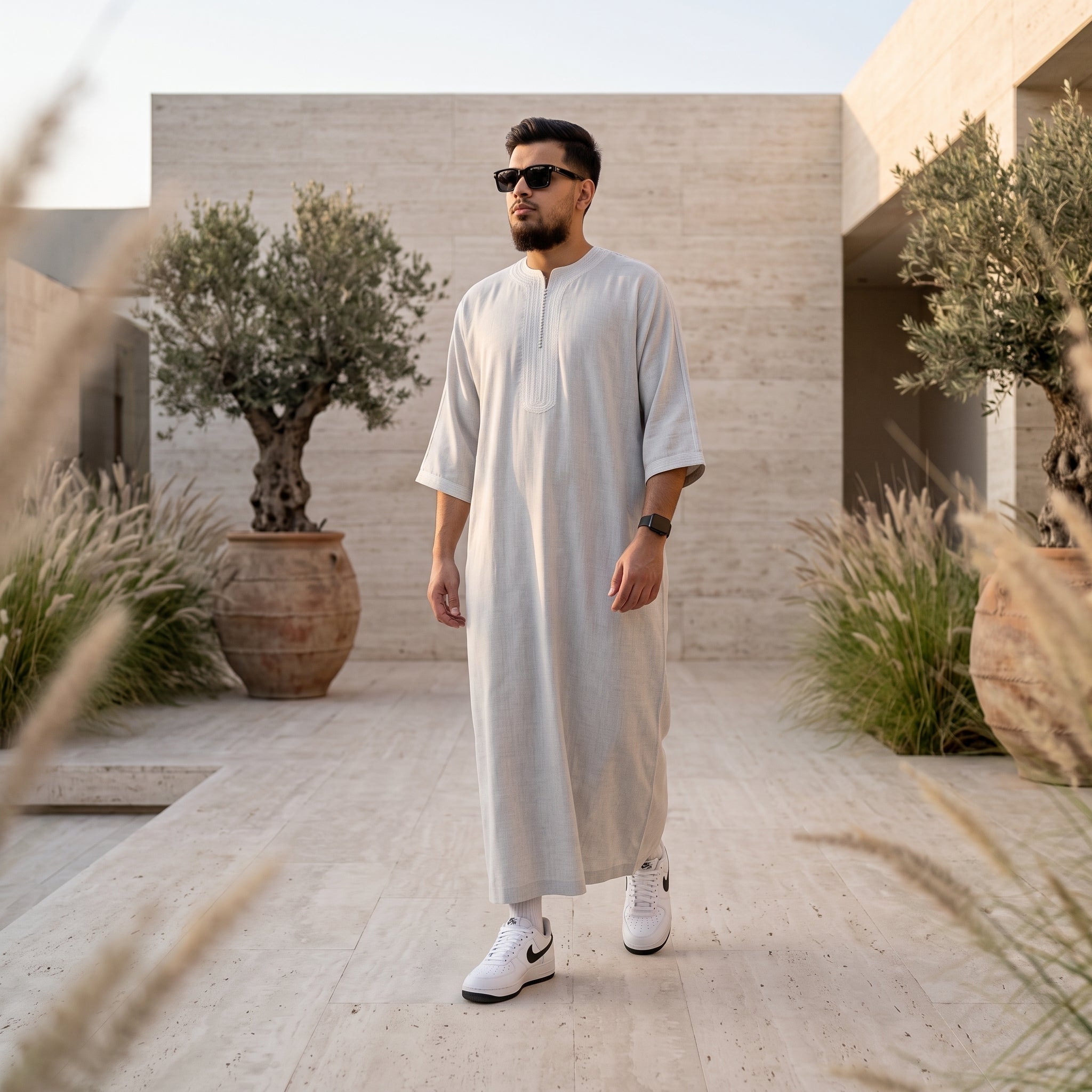
The Sunnah of dress for men rests on four things: covering the awrah with loose, modest clothing; keeping clean; wearing the best you have without arrogance; and favouring white. The Prophet ﷺ dressed simply and well, never extravagant, never neglectful. Dignity, not display.
Hey brother. There's a question underneath a lot of what we wear, even if we never say it out loud: Am I doing this right? Too plain and you wonder if you're neglecting something. Too sharp and you wonder if it's pride. Somewhere between those two worries, most of us just get dressed and hope for the best.
The Sunnah actually answers this. Clearly, and with more room than you might expect.
What is the Sunnah way for a man to dress?
The Sunnah way for a man to dress is modest, clean, and dignified — clothing that covers the awrah (navel to knee at minimum), that isn't tight or transparent, that's kept clean, and that reflects the best of what he owns without crossing into showing off. White is especially loved. Beyond that, the Sunnah leaves the style, the cut and the culture to you.
That last part matters. There is no single "Islamic uniform." A brother in Lagos, Lahore, Cairo and Toronto can each dress within the Sunnah and look nothing alike. The principles are fixed. The form is not.
Modesty (haya): covering with dignity
Modesty is the foundation, and in Islam it runs deeper than fabric. Haya is a quality of character, a sense of dignity that shows in how a man speaks, moves and carries himself. Clothing is simply its most visible expression.
Practically, three things:
-
The awrah. For men, the minimum area to be covered is from the navel to the knee. This must stay covered in prayer, in public, in front of other men.
-
Loose, not clinging. Clothing that traces the shape of the body defeats the purpose, even if it technically covers. This is why a garment that drapes works better than one that pulls — especially in sujood, where tight clothing rides up and exposes what should stay covered.
-
Not transparent. Covering means covering. If the skin shows through, the cloth isn't doing its job.
That's the floor. Most brothers who think about their dress are already past it; the question becomes what you build on top.
Cleanliness: The Prophet ﷺ cared about how he appeared
Cleanliness in Islam isn't a side detail. It runs through the whole deen — tahara is a condition for prayer itself. And the Prophet ﷺ extended that care to how he presented himself to people.
He ﷺ washed, used the siwak, kept his hair and beard tidy, and loved good fragrance. He taught that a man going to Friday prayer should bathe, put on his best clothes, and apply perfume if he has it.
There's a lesson in that beyond hygiene. Turning up clean and put-together is a form of respect for the prayer, for the people around you, and for yourself. A wrinkled shirt and a rushed appearance say something, even when we don't mean them to.
The love of white
Of all the colours, white holds a special place.
Ibn 'Abbas (may Allah be pleased with him) reported that the Messenger of Allah ﷺ said: "Wear white clothes, for they are among the best of your clothes." (Sunan Abi Dawud; Jami' at-Tirmidhi 994, graded sahih)
In another narration, Samurah ibn Jundub (may Allah be pleased with him) reported him ﷺ saying that white is purer and cleaner. (Tirmidhi 2810)
The scholars offer a simple insight into why: white shows dirt immediately. You can't hide a stain on white, so a man wearing it tends to keep it washed. The colour enforces the cleanliness.
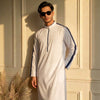
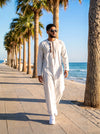
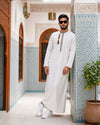
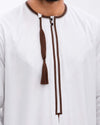
Worth being clear, because brothers often ask: white is recommended, not required. The Prophet ﷺ himself wore other colours — green garments and a black turban are both recorded. So a dark thobe for the office isn't a compromise on the Sunnah. White is simply the most beloved, and there's a reason so many brothers reach for a clean white thobe on Friday.
Wear your best without arrogance

Here's the tension most brothers feel, and the Sunnah addresses it directly.
On one side: the Prophet ﷺ said "Allah is beautiful and He loves beauty" (Sahih Muslim). Dressing well is not vanity. Turning up neat, in good clothes, is part of honouring the occasion and the people in it.
On the other: the same hadith that praises beauty warns against kibr — arrogance. And there's the well-known guidance to keep the lower garment above the ankles, with the reason given plainly: trailing it is arrogance, and Allah dislikes pride.
Read together, the line becomes clear. The problem was never the good clothes. It was the looking-down-on-people. A man can wear a simple thobe and be full of pride. A man can wear a fine one and be humble. The Sunnah is judging the heart, not the price tag.
So dress well. Just don't dress to be seen as better than the brother next to you.
Moderation: no excess, no neglect
The Sunnah sits between two ditches.
Neglect: showing up unwashed, careless, in torn clothes when you own better. That's not humility; it's indifference. The Prophet ﷺ once saw a man in shabby clothes and asked whether he had wealth. When the man said yes, he ﷺ told him that Allah likes to see the effect of His blessing on His servant.
Excess (israf): spending beyond your means, chasing labels, buying to impress. That's the other ditch, and Islam names it plainly.
The middle path: wear the best of what you actually have. Not the best you can borrow, finance, or perform. If your best is one clean thobe you've had for three years, that is your best, and it's enough.
Dressing for Friday and for prayer
Friday carries its own emphasis. The guidance is straightforward: perform ghusl, put on your best clothes, apply fragrance if you have it, and come early without pushing past people.
For prayer generally, the requirement is simply that the awrah is covered and the clothing is clean. A thobe is not required for your salah to be valid — and it's worth saying that clearly, because brothers sometimes worry about it. You can pray in ordinary clothes that meet the conditions. (More on that here: Is the thobe Sunnah?)
What the thobe offers is ease. It is fully by design, moves with you in ruku' and sujood, and takes the guesswork out.
Living the Sunnah of dress today
None of this requires you to dress like you're in seventh-century Madinah. The principles travel; the wardrobe adapts.
In practice, for a brother in the West, it usually looks like: something loose enough to pray in without adjusting, clean and pressed, above the ankles, and — when the day calls for it — the best thing you own. That might be a thobe. It might be a well-cut shirt and trousers that actually cover. Both can be within the Sunnah.
If you're new to the garments themselves, start with what a thobe is, or read the wider guide to what Muslim men's clothing is called. And if you've noticed more brothers around you dressing this way lately, you're not imagining it — more Muslim men in the West are switching to thobes.
At Furqanwear, we're a Toronto-based Canadian brand shipping from Toronto across Canada and the USA with duties included, in sizes XS to 3XL.
Dignity, decided at the start
Strip it all back and the Sunnah of dress isn't a rulebook about fabric. It's about how a man carries himself.
Clean, because you respect where you're going. Covered, because dignity isn't for display. Your best, because the day deserves it. Humble, because none of it makes you better than anyone.
You don't need a new wardrobe to start. You need one clean garment and the intention behind it.
When you're ready, browse the full range of men's thobes.