Skip to content
Is the Thobe Sunnah? An Honest, Guilt-Free Answer
- by Mahidur Furqan
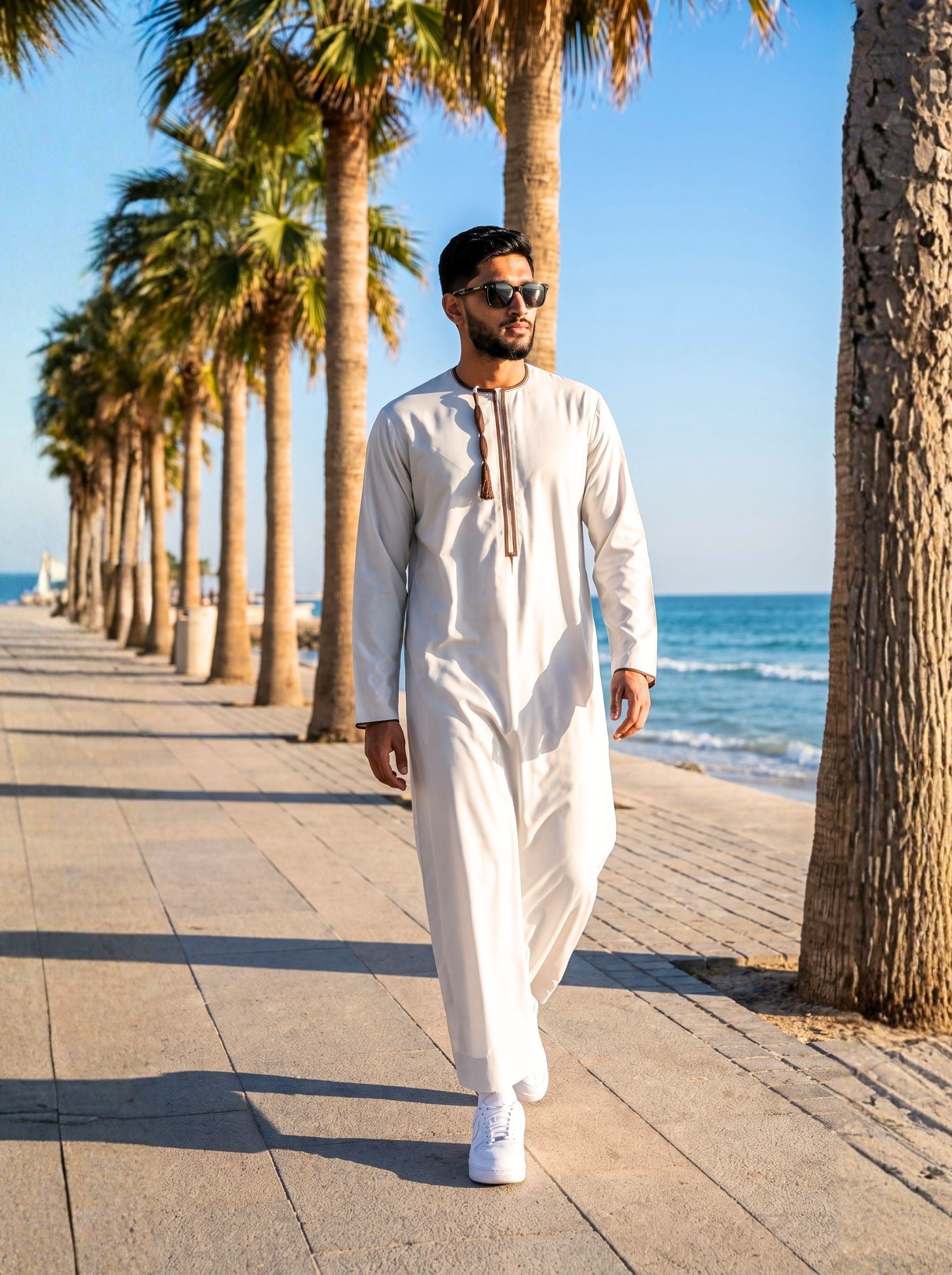
Wearing a thobe is recommended, not required. Islam asks a man to cover his body, keep his clothing clean, and dress with modesty and dignity — the thobe is one beautiful way to live that, not an obligation in its own right. So no, you are not sinning if you don't own one, and you are not a lesser Muslim in clean, modest everyday clothes.
The distinction matters, because a lot of brothers carry a quiet worry that they're falling short. They're not. The thobe is a recommended, beloved practice — the kind of thing you're rewarded for choosing, with no blame for leaving. It's worn by Muslim men across the world precisely because it's simple, humble, and unmistakably tied to the faith.
This guide answers the questions underneath the question: what Sunnah and fardh actually mean, whether skipping the thobe is a sin, why so many men reach for it anyway, and what your faith genuinely requires you to wear.
Sunnah, fardh, mustahabb: what the words actually mean
Before the thobe, the words. Most of the confusion around this question comes from mixing up categories that Islam keeps carefully separate.
Fardh is obligatory — leaving it is a sin. Covering the awrah in prayer is fardh, for instance. Wajib is near-obligatory. Sunnah or mustahabb (recommended) is the category most relevant here: an action you're rewarded for doing, with no blame if you leave it. Below that sits the simply permissible — neither rewarded nor blamed.
Wearing a specific garment like the thobe is not fardh. Scholars broadly hold that no single cultural dress is made compulsory by Islam; what's obligatory is modesty and coverage, and many garments satisfy that.
So when someone says "the thobe is Sunnah," they mean it belongs to the recommended-and-beloved category — a good thing to do, never a debt you owe. Hold that one distinction and the rest of this becomes simple.
You can read the mainstream scholarly position on Islamic dress in a recognised fiqh reference here.
Is wearing a thobe Sunnah or fard?
Recommended, not obligatory — and that difference is the whole answer. Fard is required, and its absence is a sin. A recommended act earns reward when done and carries no blame when left. The thobe sits firmly in that second category.
The obligation in Islamic dress was never a particular garment. It's the principles behind the garment: covering what must be covered, keeping your clothing clean, and carrying yourself with modesty rather than display. No school of thought makes the thobe itself compulsory. What's encouraged is the spirit the thobe expresses so naturally — humility, simplicity, dressing in a way that respects the moment and the One you stand before.
That's why you'll hear the thobe called Sunnah in the loose, everyday sense: it reflects a way of dressing the faith honours. But "reflects" is not "requires." Wear one and you're living a recommended, beloved practice. Don't, and you've left nothing you were ever obliged to keep.
Is it a sin if you don't wear a thobe?
No. Plainly, no. You are not sinning by not wearing a thobe, and you are not falling short as a Muslim for choosing other clothes.
This needs saying directly, because it's the quiet worry a lot of brothers carry into the masjid. The man who wears jeans to work all week. The one who can't afford a thobe right now. The convert who owns none and isn't sure where to begin. The brother in a hoodie who feels eyes on him at Jummah. None of them are doing anything wrong. Modest, clean clothing is the obligation — and it comes in countless forms, in every culture the ummah has ever reached.
The thobe is a choice, not a test you're failing. Guilt was never meant to be the reason a man dresses for his faith, and a garment worn out of fear loses the very dignity it's supposed to carry. If you wear a thobe, let it be because you want to — because you like who you are in it — not because you're afraid of what skipping it says about you. It says nothing. Your standing with your Lord was never hanging on a length of cloth.
Why do so many Muslim men wear the thobe, then?
Because it's a lived, everyday expression of the faith — not a rule, but a feeling, the thobe is clean, unfussy, and it carries a quiet dignity a man tends to notice the first time he wears one that actually fits him.
It's also shared across the whole ummah, which is a large part of why it resonates. The same garment takes different forms wherever Muslims are: the clean, collarless Saudi thobe, the structured Emirati cut, the Omani style, the Moroccan shape. Different threads, one idea. When a brother reaches for a thobe for Jummah or Eid, he's stepping into something millions of men step into alongside him, across languages and borders.
That's the real pull — not obligation, but belonging. It's a way to feel dressed for your deen, to stand with a certain composure, without having to announce anything. For many it also simply feels good: loose, breathable, easy to move and pray in. If you're still getting your bearings on the garment itself, here's what a thobe actually is.
The thobe across the Muslim world
Part of what makes the thobe feel bigger than fashion is its reach. It began as an ankle-length robe suited to the hot, dry climates of the Arabian Peninsula — loose, breathable, practical — and spread outward with the faith until it became common dress far beyond where it started. Encyclopaedia Britannica describes the thawb as an ankle-length garment usually woven of white cotton, worn across the Arab world and adopted well past it.
Today it's worn from the Gulf to South Asia to West Africa to Toronto, under a dozen names — thawb, jubba, kandura, dishdasha — for what is essentially the same modest robe. That spread is exactly why the question "do you have to be Arab to wear one?" answers itself: the garment stopped being any single culture's property a long time ago. It belongs to the ummah now.
Understanding that lineage takes the pressure off. You're not borrowing someone else's tradition when you wear a thobe. You're joining one that was already yours.
What does Islam actually require you to wear?
The requirement is about principles, not a product. Cover the parts of the body that must be covered, keep your clothing clean and free of impurity, and dress modestly — not tight, not flashy, not careless. Meet those and your dress is sound, whatever the garment happens to be.
For prayer specifically, the essentials are covering the awrah and cleanliness. The practical detail — what to wear underneath, how coverage works, dressing properly for salah — is its own subject, and we've set it out separately in what to wear under a thobe. Start there if that's the question you actually came in with.
The thobe simply makes those principles easy to live. It's loose, modest by design, and covers naturally, which is a big part of why brothers gravitate to it. But the garment serves the principle — the principle never depended on the garment. Get the principle right in ordinary clothes, and you've met your obligation just the same.
Can you wear a thobe casually, or only for prayer and Eid?
Casually, without hesitation. The thobe isn't reserved for the masjid or the two Eids — plenty of brothers wear it as everyday clothing: at home, running errands, or simply because it's comfortable and they feel like themselves in it.
There's no rule that a thobe is "too much" for an ordinary day. If anything, wearing it casually is how it stops feeling like a costume and starts feeling like yours. Layer it the way you'd layer anything else — trainers, a jacket over the top when Toronto turns cold — and it sits easily inside a modern wardrobe rather than standing apart from it.
It also helps to know the thobe travels under many names, so don't let the vocabulary trip you up; here's the plain guide to the many names for the same robe. Daily, weekly, or only for the big days — all of it is fine. Wear it as much or as little as you like.
The thobe is one part of a bigger picture — see the Sunnah principles of men's dress.
Wear it because you choose to
Here's where it lands. The thobe isn't required of you — and that's exactly what gives wearing one its weight. A duty is carried; a choice is owned. When you put on a thobe, you're not ticking a box or settling a debt. You're deciding, freely, to dress for your faith with dignity.
If that's a choice you want to make, make it well. Explore the Furqanwear men's thobes collection and find one cut for you — the right length, the right fit, in sizes built for real bodies. Not borrowed. Not forced. Yours.