Skip to content
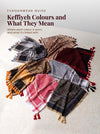
Keffiyeh Colours and What They Mean
- by Mahidur Furqan
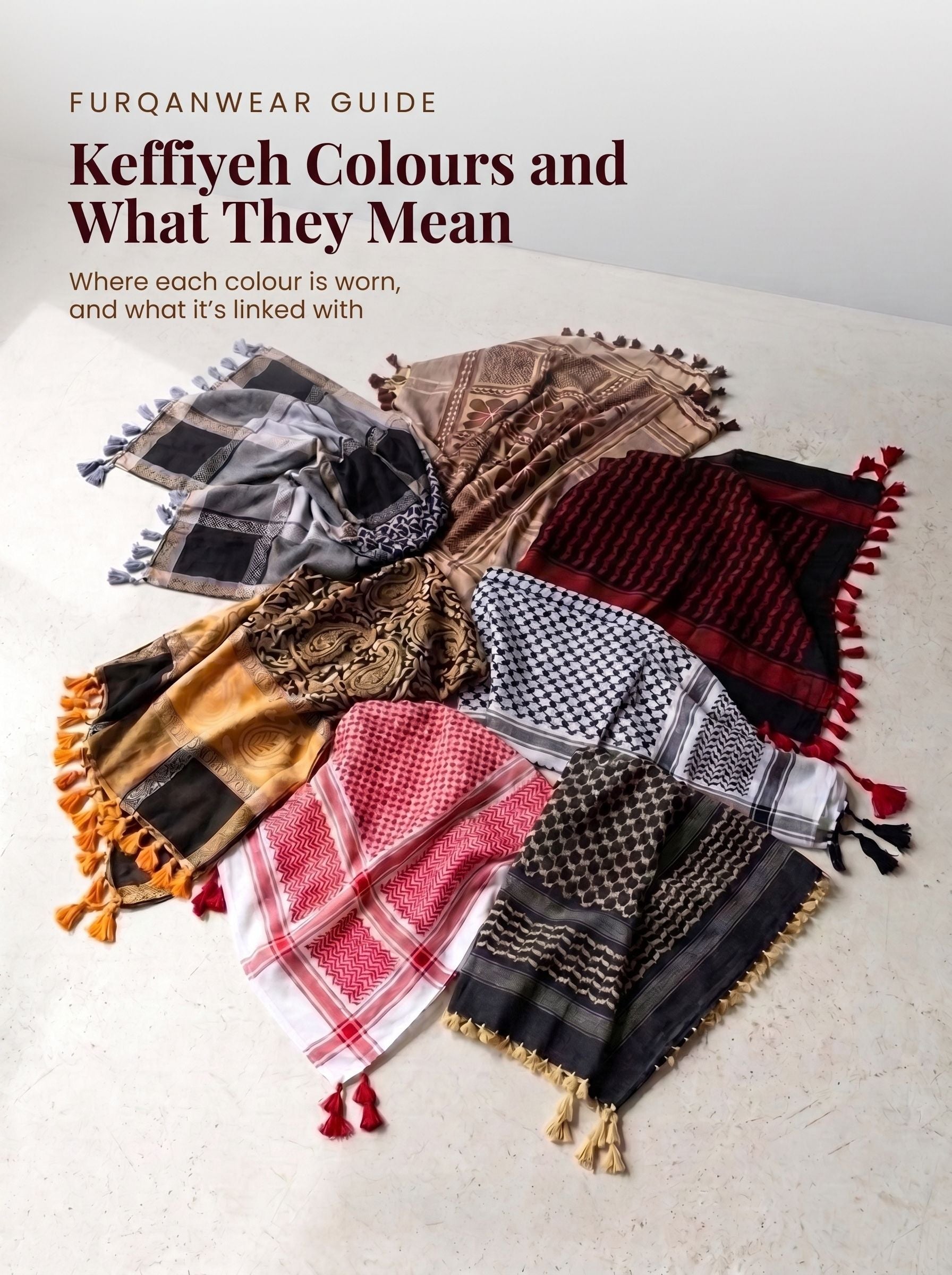
Keffiyeh colours point to a region more than to a fixed code. Black and white is the Palestinian keffiyeh, red and white belong to Jordan and the Arabian Gulf, and plain white is the Gulf ghutra. Newer colours such as brown, yellow, orange, grey or red and black carry no single traditional meaning and are mostly chosen for style.
This guide explains each colour, where it is worn and what people usually connect it with, so you can choose a keffiyeh with confidence. It is written by Furqanwear, the Toronto-based Islamic clothing brand, which makes woven, 100% cotton keffiyehs in twelve colourways.
Keffiyeh Colours at a Glance
|
Colour |
Where it is mostly worn |
What it is usually linked with |
Furqanwear version |
|
Black and white |
Palestine (also Syria and Iraq) |
Palestinian identity; worn worldwide in solidarity |
Classic Black & White, Black (both currently sold out) |
|
Red and white |
Jordan, Saudi Arabia and the Gulf |
Bedouin heritage and Jordanian national dress |
|
|
Plain white (ghutra) |
Saudi Arabia, the UAE, Qatar, Kuwait, Bahrain |
Everyday and formal Gulf dress, often with an agal |
White (white-on-white pattern, currently sold out) |
|
Red, green, white and black |
Worldwide |
The colours of the Palestinian flag; worn to show support |
Watermelon (currently sold out) |
|
Red and black |
Worldwide |
No fixed meaning; a modern mix of the two classic styles |
|
|
Brown, yellow, orange, grey, gold |
Worldwide |
No fixed meaning; chosen for style |
Chocolate & Cream, Black & Golden Yellow, Black & Orange, Slate & Silver, Obsidian & Gold, Black & Gold (sold out) |
Black and White
Black and white is the colour most people picture when they hear the word keffiyeh. It is the traditional keffiyeh of Palestine, and it is also worn in Syria and Iraq. Farmers and travellers wore it for centuries to protect the head and neck from sun, wind and sand, and during the twentieth century it became a symbol of Palestinian identity. Even the name points back in history: as Encyclopaedia Britannica notes, keffiyeh means "relating to Kufa", a city in Iraq. Today it is worn around the world, by Arabs and non-Arabs alike, as a sign of support for Palestine.
The black lines on the white base form the familiar fishnet pattern, bold border lines and rows that look like leaves. People often describe these as fishing nets, trade routes and olive trees, although these readings come from folk tradition rather than any fixed rule. You can read more about the pattern in our guide to what a keffiyeh is.
All-black and black-on-black keffiyehs are a modern variation. They keep the woven pattern but drop the white, so the design shows only up close. They are popular as everyday winter scarves and do not carry a separate traditional meaning.
Red and White
Red and white is the keffiyeh of Jordan and the Arabian Gulf. In Jordan it is part of national dress, worn on formal occasions and long associated with the country's desert police. In Saudi Arabia and the Gulf the same red-and-white cloth is folded into a triangle and worn on the head, held in place with a black cord called an agal, usually over a white Saudi thobe. In the Gulf this red-and-white style is often called a shemagh, and in Jordan it is sometimes called a hatta.
The red usually comes in a dense fishnet pattern with a wide band of zigzag lines along one edge. Jordanian versions are often finished with tassels, while many Gulf versions have a plain hem.
Plain White: The Ghutra
A plain white scarf, the ghutra, is the everyday headdress across much of the Gulf, including Saudi Arabia, the United Arab Emirates, Qatar, Kuwait and Bahrain. It is lighter and simpler than a patterned keffiyeh, it is worn for work, prayer and official occasions, and it is often held with an agal. Some white keffiyehs, like ours, carry a white-on-white woven pattern, which keeps the clean look of a ghutra while still showing the keffiyeh design up close. For the differences in name and size, see our guide to the keffiyeh, shemagh and ghutra.
Jordanian vs Palestinian Keffiyeh
The quickest way to tell them apart is colour. A red-and-white keffiyeh is usually Jordanian or from the Gulf, while a black-and-white keffiyeh is usually Palestinian. Both use similar woven patterns, so the colour does most of the talking. Wikipedia's keffiyeh article describes the regional styles in more detail. If you are buying a keffiyeh specifically to show support for Palestine, black and white is the colour most people will recognise for that purpose.
Green, Blue and the Flag Colours
Green, blue and multi-coloured keffiyehs are less common and more recent than the classic styles. Keffiyehs that combine red, green, white and black use the colours of the Palestinian flag, and people wear them to show support. Beyond that, people read different messages into single colours such as green, so there is no one agreed meaning. Blue keffiyehs, usually blue and white, are a newer style that some makers connect with the sea and the sky; they are worn mainly for their look. If you prefer a colour that simply says heritage, black and white or red and white are the clearest choices.
Modern Colours: Brown, Yellow, Orange, Grey, Red and Black
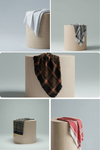
Most newer colourways keep the traditional woven pattern and change only the palette. They have no fixed traditional meaning, which makes them a personal choice rather than a regional signal. At Furqanwear these include the soft, earthy Chocolate & Cream, the golden Black & Golden Yellow, the copper-toned Black & Orange, the cool grey Slate & Silver, the bold Obsidian & Gold and the dark Black & Scarlet, which mixes the black base of one classic style with the red of the other.
A common question is the difference between a red keffiyeh and a red and black one. A red keffiyeh usually means red on a white base, the traditional Jordanian and Gulf style. A red and black keffiyeh puts the red pattern on a black base instead. It looks darker and more modern, and it does not belong to any one region.
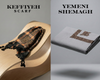
Looking for paisley and geometric colours instead of the keffiyeh pattern? That is a different scarf: see our Yemeni shemaghs.
Does the Colour Matter? Choosing Yours
No keffiyeh colour is forbidden, but the colour does say something, so it helps to choose with intention. Start from where and how you will wear it:
-
To show support for Palestine: black and white is the colour most people recognise for that purpose.
-
For a traditional Gulf or Jordanian look: red and white, ideally with an agal and a white thobe.
-
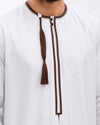
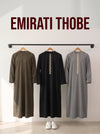
For Jumu'ah and Eid: a plain thobe with a patterned keffiyeh is the classic pairing. Red and white over a white thobe is the Gulf look, while black or navy thobes pair well with lighter or brighter keffiyehs.
-
For everyday wear: pick what suits your wardrobe. Darker keffiyehs hide marks and suit winter coats; lighter ones brighten dark clothes and stay cooler in strong sun.
-
For a quieter look: earthy and grey tones such as brown and cream or slate and silver draw less attention than the classic contrasts.
Browse our men's thobes to put the look together.
Whichever colour you choose, every Furqanwear keffiyeh is woven rather than printed, made of 100% cotton and sized 49 × 49 inches. See all twelve colourways in our keffiyeh collection.