Skip to content
Which Yemeni Shemagh Goes With Your Thobe?
- by Mahidur Furqan
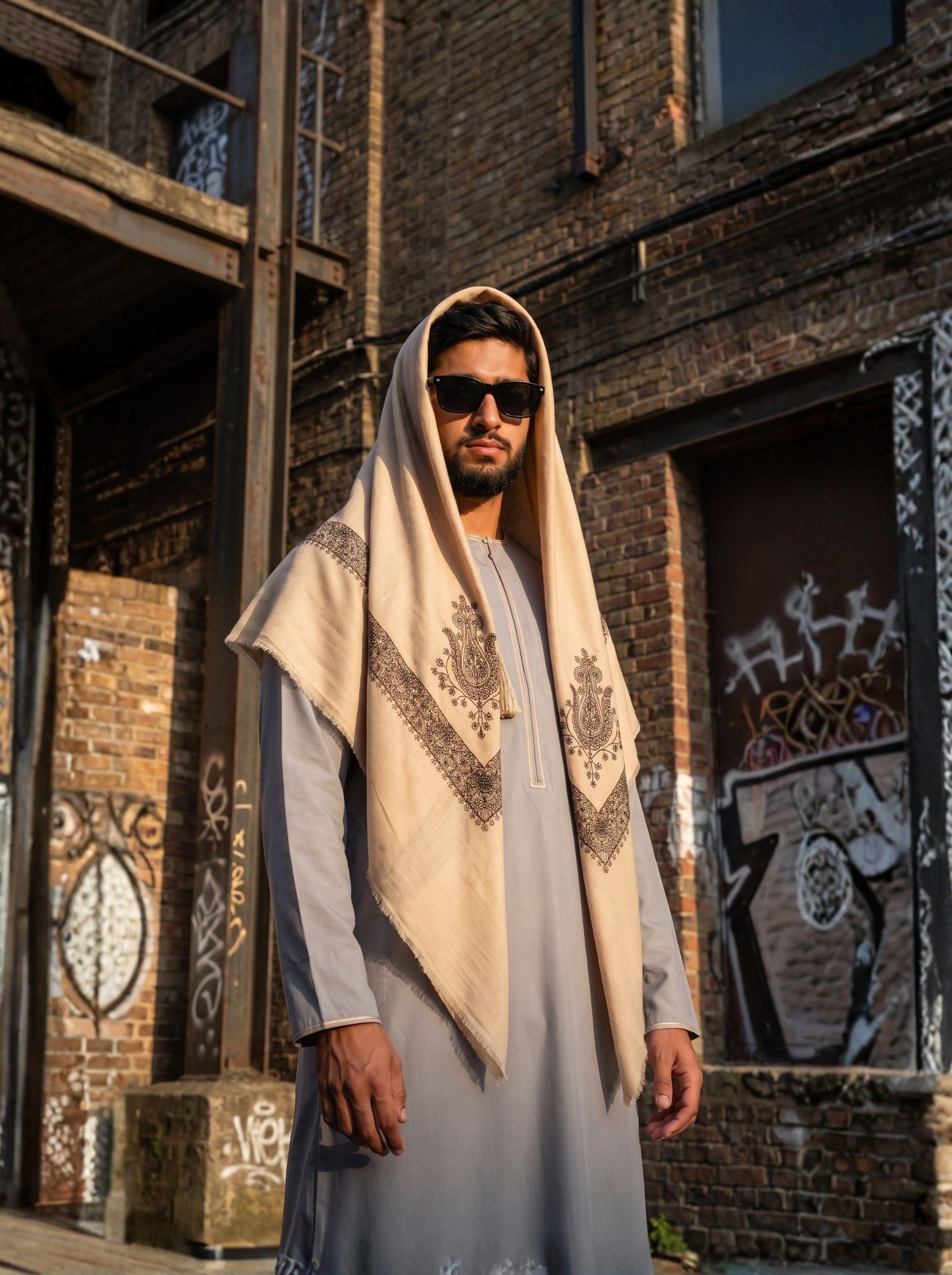
To pair a Yemeni shemagh with a thobe, match the shemagh's border colour to the thobe, not its pale ground. A cream ground with a navy border suits a white thobe. A warm brown or rust border suits black or charcoal. Yemeni shemaghs are 52" × 52" cotton with a pale ground and a paisley border carrying the second colour.
You have the men's thobe. You have the Yemeni shemagh. You put them together in the mirror and something is off — not wrong exactly, just not right. Usually it is the colour, and usually it is fixable in one move.
We stock six thobe lines and eighteen shemagh colourways, so we have laid most of these combinations out on a table. Here is what works.
|
Your thobe |
Yemeni shemagh |
Why it works |
|
White Saudi |
Cream & Navy — Type 31 |
Navy border reads formal against white without going stark |
|
White Saudi |
Beige & Black — Type 7 |
Highest contrast in the range. Sharp, deliberate |
|
Black or charcoal |
Cream & Chocolate Brown — Type 4 |
Warm tones lift a dark thobe instead of vanishing into it |
|
Grey Omani |
Beige & Charcoal — Type 30 |
Charcoal ties back to the thobe; sand-beige lifts it |
|
Navy Emirati |
Cream & Navy — Type 31 |
Matched border, cream ground keeps it from going heavy |
|
Sand or beige Moroccan |
Cream & Beige — Type 32 |
Full tonal layering — the quietest, most Yemeni look you can build |
|
Any dark thobe |
Arabic Grey & Old Rose — Type 2 |
The composed one. Present without being loud |
Every Yemeni shemagh in this guide is $30 – $35 CAD. 52" x 52", one universal size.
Why does the border colour matter more than the base?
Pick up any Yemeni shemagh and you will find the same structure. A pale ground — cream, sand, grey — then a dense paisley medallion at the corner and an ornate border running the edges.
The ground is what touches your shoulders. The border is what people see.
That is why cream-based shemaghs go with nearly everything: the ground stays neutral and the border does the work. It is also why matching the base to your thobe is the most common mistake we see. Two creams sitting against each other read as one flat block, and the shemagh stops registering as a separate piece. A cream ground with a navy border against a white thobe reads as a decision.
These pairings come from putting the pieces side by side in our Toronto warehouse. Colour on a screen and colour on cloth are not the same thing, and a paisley border shifts noticeably depending on what sits underneath it.
Which Yemeni shemagh goes with a white thobe?

Any of them — which is exactly why men overthink this one.
A white Saudi thobe is a blank ground. It takes every border colour in the range without complaint. So the question becomes what you want the shemagh to say.
For formal occasions, choose a navy or black border. Cream & Navy is the safer of the two — navy carries weight without the hard edge black brings. Beige & Black is the sharpest pairing we sell, and it suits a man who wants the contrast to be obvious.
For warmth, choose brown or rust. Cream & Chocolate Brown against white is softer and older-looking — closer to how the piece is worn in Yemen than how it gets styled in a lookbook.
One thing to watch: a bright white thobe and a cream ground sit slightly apart in tone. That is fine — it reads as layering. What does not work is an off-white thobe with a cream shemagh, where the two whites read as a laundry problem rather than a choice.
Which shemagh works with a black or charcoal thobe?
Go warm.
Brown, rust and old rose all lift a dark thobe. The pale ground does the lifting, and the warm border keeps the whole thing from looking like a two-tone uniform.
What fails here is charcoal on charcoal. A Beige & Charcoal shemagh over a charcoal thobe loses its border entirely — from any distance it reads as a plain cream scarf and the paisley work disappears. If you own a dark thobe, the borders that survive it are the warm ones.
Cream & Chocolate Brown is the pairing we recommend most often for black. Arabic Grey & Old Rose is the quieter alternative if you want something that holds back.
What goes with a grey or navy thobe?
Grey. Tonal is the answer. Beige & Charcoal over a grey Omani thobe is calm and correct — the charcoal border echoes the thobe and the sand ground keeps it from going flat. Adding a strong red or navy here fights the thobe instead of finishing it.
Navy. Match the border. Cream & Navy over a navy Emirati thobe reads as one considered outfit rather than two pieces that happened to end up together. This is the clearest case in the guide where matching works — because you are matching border to garment, not ground to garment.
What about a Moroccan djellaba or sand-toned thobe?
This is where the Yemeni shemagh comes from, and it is the pairing that looks most at home.
Layer tone on tone. Cream & Beige over a sand Moroccan djellaba is the least dramatic combination here and the one that looks least like an outfit and most like clothing. Taupe and rust borders work the same way.
If you have only seen shemaghs styled as high-contrast statement pieces, this will look understated to the point of plain in a photograph. In person, it does not. It reads as someone who dresses this way, not someone dressing up.
Can you wear a patterned shemagh with an embroidered thobe?
We would not.
Two patterns fight. An embroidered thobe with a paisley shemagh gives the eye nowhere to rest, and no amount of colour matching resolves it. If your thobe carries detail at the collar or cuffs, choose a shemagh with a narrow border and a plain ground, and let the thobe stay the detailed piece.
The same rule applies in reverse. If you want the shemagh to be the piece people notice, wear a plain thobe underneath it.
Some of this is preference rather than rule. Grey and old rose read composed to us and dull to others. If you are undecided, order a cream ground — it works against every thobe we sell, which is why it is the one that moves fastest.
Does the way you wear it change which one to choose?
Yes, and this is the part most guides skip.
Head covering. The border frames your face. High contrast works here — Beige & Black or Cream & Navy give the fold a defined edge. A low-contrast pairing looks washed out around the head.
Shoulder drape. The border falls at your chest and down your back, visible from every angle. This is where tonal pairings shine. Cream & Beige over a sand djellaba is quiet, but it is quiet on purpose.
Neck wrap. Most of the shemagh is hidden. Only the folded edge shows, which means the border is nearly all you see. Choose a strong border, or the piece disappears under a jacket.
Same shemagh, three different jobs. If you mostly wear yours at the neck through a Canadian winter, buy for the border. If you mostly drape it, buy for the ground.
Which shemagh for Eid, Jummah and nikah?

Jummah. Whatever pairs cleanly with what you already own. This is the weekly one, not the special one, and a shemagh you reach for without thinking is worth more than one you save.
Eid salah. The one people overthink. You are outside before sunrise; it is cold in Toronto in March, and the shemagh is doing two jobs — it has to sit properly for salah and still work wrapped at the neck on the walk home. Cream ground, defined border. It handles both.
Nikah or walima. Shoulder drape over a white or navy thobe, border showing at the edge. Cream & Navy is the pairing we would put a man in if he asked once and did not want to think about it again.
Does the season change the pairing?
Somewhat.
Summer favours pale grounds and lighter borders — cream and beige, worn draped rather than wrapped, so the cotton can move. Winter favours darker borders, because the shemagh is usually at the neck over outerwear and needs to hold its own against a coat.
The cloth itself does not change. It is 52" x 52" breathable cotton either way — light enough for July, substantial enough for February. What changes is how much of it shows.
Do you need an agal with a Yemeni shemagh?
No.
The agal is the black cord used to hold a Saudi or Emirati ghutra flat on the head. Yemeni styling does not use one. The cloth is wrapped rather than draped, and the wrap holds itself.
That is part of what separates a Yemeni shemagh from the red-and-white Gulf shemagh most guides describe. Different cloth, different pattern, different method.
If you want the agal look, you want a ghutra. If you want the paisley, you want this. Here is the full difference between a keffiyeh and a shemagh if the naming is still unclear.
Which Yemeni shemagh should you buy first?
Match the border, not the base. Keep one piece plain. Buy for how you actually wear it.
That is most of it.
The rest is preference and there is no rule here that a man in Sana'a would recognise as a rule. He owns two or three. He wears whichever one is folded on top. It works because the cloth was made to work.
Start with a cream ground and a defined border. It works against every thobe we sell; it survives being your only one, and it will still be right in five years when you own four more.