Skip to content
Saudi Thobe Styles: Collars, Cuffs & How to Choose
- by Mahidur Furqan
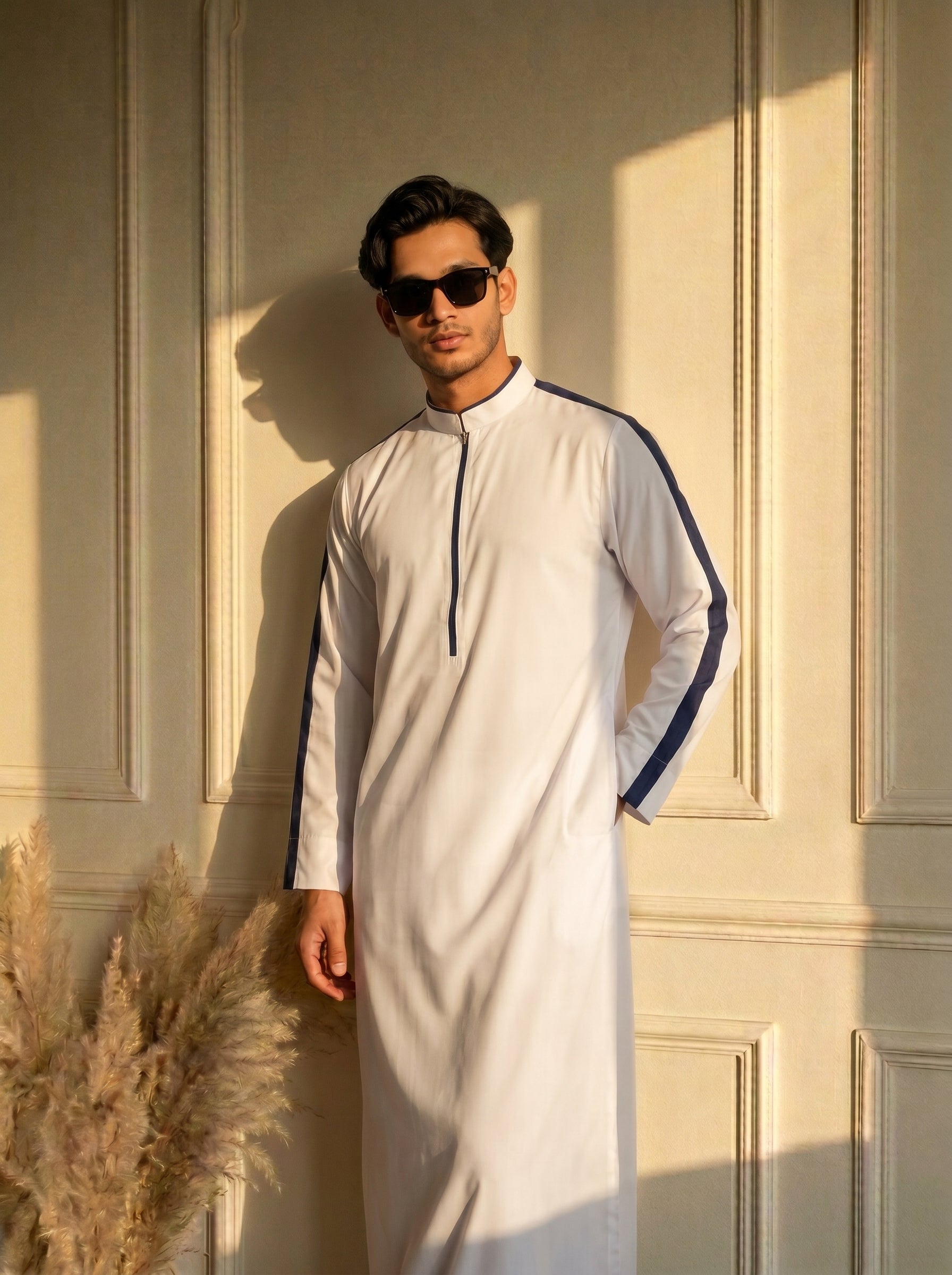
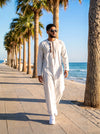
Saudi thobe styles are defined by four things: a structured standing collar, a straight cut from shoulder to ankle, buttoned cuffs, and the detailing that runs down the front placket. The modern Saudi cut drops the chest pocket and the two-button collar closure for a cleaner neckline.
Most guides will tell you a thobe is a long robe and leave it there.
But if you have ever stood in front of a rail of them, or scrolled through forty listings that all look the same, you know the useful question is different. Not what is a thobe. What separates this one from that one and which one is right for you.
That is what this covers.
What Defines the Saudi Cut?
The Saudi thobe is cut closer to the body than the Gulf styles beside it. Structured through the shoulder, falling straight to the ankle, with sleeves that end in a buttoned cuff rather than an open hem.
You will read elsewhere that the Saudi thobe is loose and flowing. That describes the Emirati kandura and the Omani dishdasha better than it describes this. The Saudi cut is the tailored one. Closer to a dress shirt extended to ankle length than to a robe.
Three markers, then:
-
A structured collar that stands at the neck
-
A straight silhouette with no flare through the body
-
Buttoned cuffs at the wrist
Everything else the collar closure, the placket, the embroidery, the colour is where style lives. That is what the rest of this guide walks through.
If you already know the silhouette you want, the Saudi thobe collection runs white through copper brown.
Saudi Thobe Collar Styles
The collar is the first thing anyone reads on a thobe. It sets whether the garment says formal, everyday, or ceremonial before a single other detail registers.
The structured collar
A standing band collar, sometimes called a mandarin collar, that closes clean at the neck with no fold and no lapel. This is the modern Saudi standard and the one you will see most often on younger men in the Gulf and across the West.
It reads sharp without reading stiff. Nothing interrupts the line from the jaw to the placket.
The traditional two-button collar
The older Saudi form. A taller, stiffer stand collar closed with two buttons, cut to sit under a ghutra and agal.
This is the detail that historically separated Saudi thobes from their neighbours; Qatari, Bahraini and Kuwaiti collars typically use a single button or none at all. It is more formal, more traditional, and more common among older men and in ceremonial settings.
Collarless
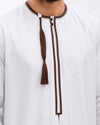
Not a Saudi style. The Emirati kandura and the Omani dishdasha are both collarless, finished instead with a tassel at the centre of the neckline on the Emirati, at the side on the Omani.
If you are weighing the two traditions against each other, we broke it down properly here: Saudi thobe vs Emirati kandura.
Placket Styles — Where Saudi Thobes Actually Differ
The placket is the vertical panel running down the centre of the chest. On a shirt it holds the buttons. On a Saudi thobe it is where nearly all the design decisions get made.
Plain placket. Nothing but a clean seam. The whole garment rests on cut and fabric. Hardest to get right, because there is nothing to hide behind.
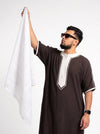
Contrast placket. A strip in a different colour running the length of the chest, sometimes carried down the sleeve. Modern, graphic, and the most visible style choice you can make on a thobe.
Tonal placket. Detailing stitched in the same shade as the fabric. You see it in the texture at close range, not from across a room. Formal without announcing itself.
Embroidered placket. Gold, bronze or silver worked into the placket and often the collar. The most ornate option built for occasions, not for Tuesdays.
That last distinction matters more than most people expect. A tonal placket will carry you through Jummah, a workday and a family dinner. An embroidered one will look overdressed at two of those three.
Cuff and Sleeve Styles
Saudi thobes almost always use a buttoned cuff, a barrel cuff, closed with one or two buttons, the same construction as a dress shirt.
Two variations worth knowing:
Cufflink cuffs. Some traditional Saudi thobes come with an unbuttoned cuff designed to take cufflinks — kabak in Arabic. Purely formal. If you have ever seen a Saudi thobe with an open, doubled-back cuff and wondered what was missing, that is what it was.
Open hem. No cuff, no button, the sleeve simply ends. Common on Emirati and Omani styles, uncommon on Saudi ones.
Sleeve length runs full to the wrist on every traditional Saudi thobe. Half-sleeve versions exist, but they belong to the Moroccan and North African tradition rather than the Gulf.
Plain vs Embroidered: Which Do You Actually Need?
This is the decision most brothers get wrong, and it usually goes the same direction: buying the ornate one first.
Plain or tonal is the thobe you will wear most. Jummah, daily wear, work, family gatherings. It does not compete with anything and it does not date. If you own one Saudi thobe, this is the one.
Our Copper Brown sits here — tonal detailing down the chest, warm enough for everyday wear, considered enough for Friday.
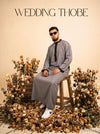
Embroidered is the occasion garment. Nikah, walima, Eid evening, milestone gatherings. Gold or bronze across the collar and placket, built to be photographed.
The Embroidered Black carries gold on the collar and placket — high contrast, unmistakably formal. The Embroidered Grey does the same in a softer register, where the gold sits closer to the fabric tone.
Buy the plain one first. Buy the embroidered one when you have somewhere to wear it.
Saudi Thobe Colours and What They Signal

White. The Sunnah preference for Jummah and Eid Salah, and the colour the Prophet ﷺ encouraged. Still the most worn thobe colour on earth. Shows everything, which is part of why it reads as care.
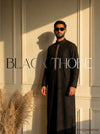
Black. Formal, evening, deliberate. Reads as presence rather than ceremony. Warmer in direct sun than white, so a poor choice for outdoor Eid prayer in high summer. The Artisan Black sits here — tonal, no embroidery, structured collar. Black without the occasion tax.
Grey and silver. The colour almost nobody owns. Lighter than black, warmer than white, and it takes gold detailing more softly than black does.
Brown and earth tones. Everyday. Warm, grounded, forgiving of a long day in a way white is not.
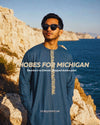
Navy and deep blue. A newer addition, popular among younger men in the West who want an alternative to black.
Colour carries more meaning here than in most menswear. White at Jummah is a choice anyone in the room will read. So is black at a nikah.
Which Saudi Thobe Style for Which Occasion
|
Occasion |
Collar |
Placket |
Colour |
|
Jummah |
Structured |
Plain or tonal |
White (Sunnah preference) |
|
Eid Salah |
Structured |
Plain or tonal |
White |
|
Eid evening |
Structured |
Embroidered |
Black, grey |
|
Nikah / walima |
Structured or two-button |
Embroidered |
Black, grey, white |
|
Daily wear |
Structured |
Plain or tonal |
Brown, grey, navy |
|
Travel |
Structured |
Plain |
Dark or mid-tone |
One rule underneath all of it: the more the placket does, the fewer places the thobe belongs. Plain goes everywhere. Embroidered goes somewhere specific.
Fit: The Part Most Guides Skip
A Saudi thobe should sit close through the shoulder and fall straight from there. Not tight through the chest. Not tented from the neck down.
The shoulder seam is the thing to check. It should land where your shoulder actually ends. Everything below follows from that — if the shoulder is right, the drape is right.
Length runs to the ankle bone. Shorter looks unfinished. Longer catches underfoot in sujood.
This is where a lot of imported thobes fail in the West. Gulf sizing is cut for Gulf builds, and a size large from Riyadh is not a size large in Toronto. Ours run XS to 3XL, cut for Western builds.
Measure your shoulder width before you order. It saves more returns than any other single check.
How to Style a Saudi Thobe
The structured collar does most of the work. You do not need to add much.
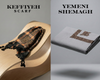
For Jummah and Eid Salah, a white kufi and nothing else. For nikah and formal gatherings, a keffiyeh or Yemeni shemagh over one or both shoulders — white against black, black against white or grey.
For daily wear, nothing. Clean thobe, clean shoes, done.
Choosing Yours
Start with where you will wear it most, not where you would most like to be seen in it. Most brothers need the everyday thobe and buy the occasion one.
Structured collar, plain or tonal placket, a colour you will reach for on a Tuesday. That is the thobe that earns its place in the wardrobe.
Browse the full Saudi thobe collection — white through copper brown, sizes XS to 3XL, shipped from Toronto.