Skip to content
Which Moroccan Thobe Should You Buy? Different Colourways, One Answer Each
- by Mahidur Rehman
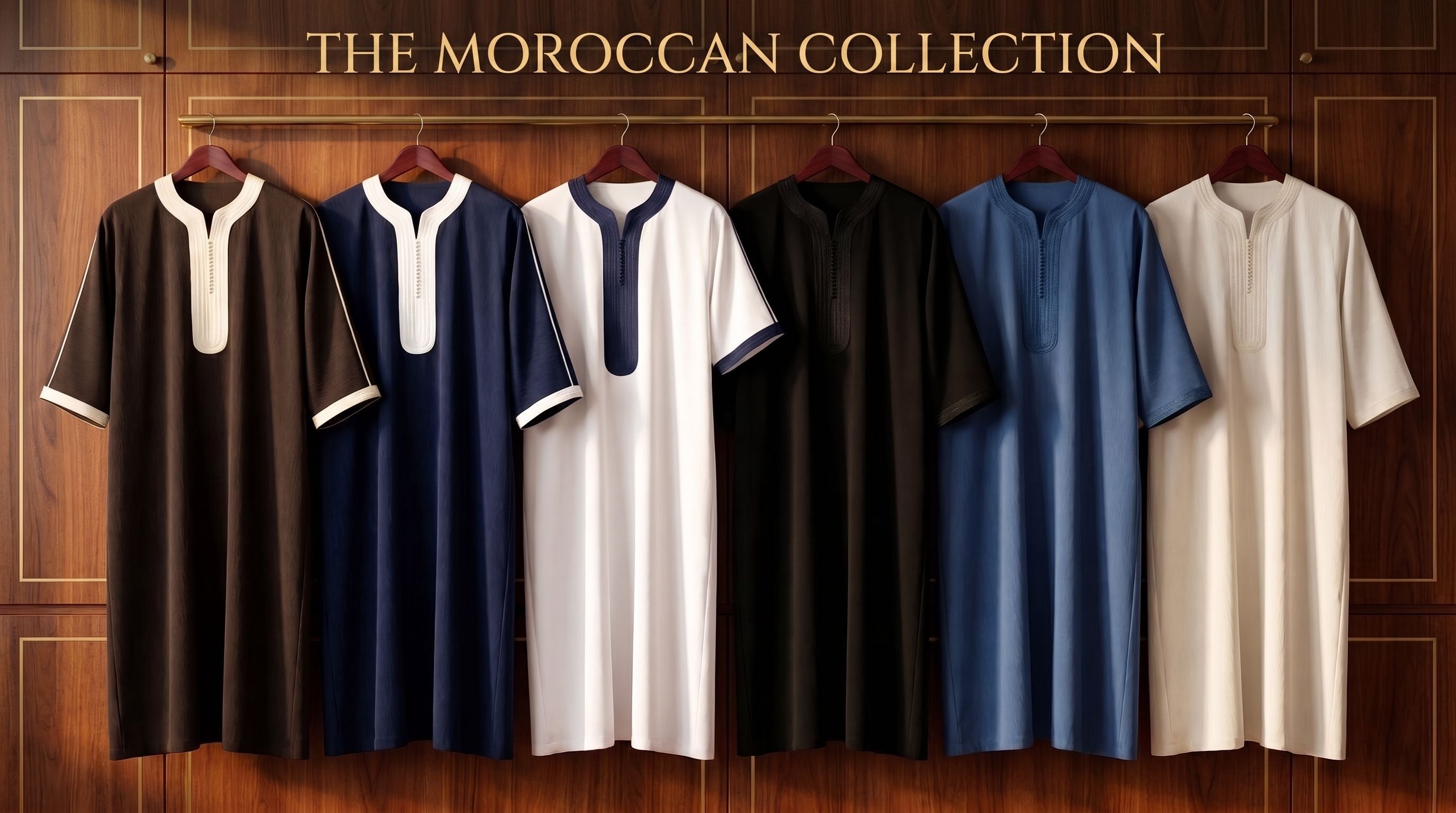
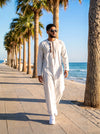
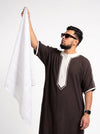
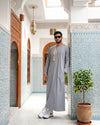
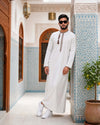
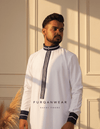
Furqanwear's Moroccan thobes are half-sleeve and open-necked, with sfifa embroidery hand-run along the chest and collar, sized XS–3XL. Black is the safest first buy. Off-white suits Jummah. Dark green carries evening. This guide gives one answer per situation rather than a list.
Ten options are a good problem until you are standing in front of them.
Most colour guides will tell you to hold gold and silver fabric up to your face and work out your undertone. We will get to that. But it is not where the decision actually lives, and it is not what most brothers are asking when they message us.
They are asking: which one will I actually wear?
One thing up front. This is a guide to our own colourways. It is not a neutral roundup of the market. We make these, we hold them in a warehouse in Toronto, and we check them before they ship. Read it knowing that.
What makes a Moroccan thobe different?
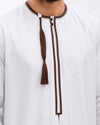
The Moroccan cut is half-sleeve and open-necked, with sfifa — the ornamental braid trim Moroccan tailors run along seams and openings — hand-stitched at the chest and collar. It is a specialist craft rather than a finishing touch. In December 2025, UNESCO added Moroccan caftan craft, including the braid and embroidery work sfifa belongs to, to its Representative List of the Intangible Cultural Heritage of Humanity.
Saudi and Emirati thobes are long-sleeved and usually plain. That is the whole difference, and it changes how the garment wears.
The half-sleeve Moroccan thobe is closest to the gandoura, the light, hoodless tunic that sits alongside the djellaba and jabador in traditional Moroccan clothing.
Every one of Furqanwear's Moroccan thobes is cut this way. What changes between them is colour, and what the stitching does against it.
The fabric is a 50/50 cotton-polyester blend, and it is worth being straight about what that means. It does not breathe like pure cotton. It also does not crease like pure cotton, and it goes in a machine rather than a hand wash. If maximum breathability is your only priority, buy linen from someone. If you want a thobe you can wear on a Friday, wash on a Saturday, and wear again without ironing, the blend is the trade we made on purpose.
New to the garment entirely? Start with what a thobe is, then come back.
Your first Moroccan thobe
Take the black.
Not because it is the best one. Because it is the one you will wear most while you are still working out whether you are a man who wears a thobe on a Tuesday.
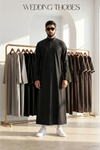
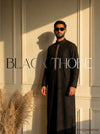
The black Moroccan thobe runs tonal — black thread on black cloth — so the sfifa reads at conversational distance rather than across a room. That matters more than it sounds for a first thobe. Nothing about it announces itself. You can wear it to Jummah, to dinner, to a gathering where you are not sure how dressed people will be, and it holds in all three.
Buy the colour you cannot get wrong first. Buy the one you love second.
Best Moroccan thobe for Jummah
Off-white.
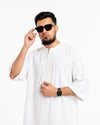
White has always been the colour most closely associated with Friday prayer, and it is widely favoured across the Muslim world. The off-white Moroccan thobe is the softer version of it — warmer under masjid lighting, less stark in photographs, and considerably more forgiving about the marks a bright white will show by the second week.
If you want one thobe specifically for Jummah, this is it. If you want one thobe for everything, go back and read the section above.
Best Moroccan thobe for Eid
A two-tone.
Eid morning is the one day of the year when the room is genuinely dressed. Contrast earns its place.
The navy and white Moroccan thobe puts navy as the base with white running through the sfifa. The white and navy Moroccan thobe reverses it — white base, navy detail. Same cut, same craft, opposite weight.
Which one depends on the light. White-base reads brighter in a courtyard at sunrise. Navy-base holds better indoors and photographs deeper.
Best Moroccan thobe for a nikah or walima
Navy blue or dark green for an evening hall. Off-white for a daytime ceremony.
Ceremony rooms are lit low and warm, and light colours wash out in them. Depth is what photographs well.
The navy blue Moroccan thobe reads formal without reading like a uniform — it is the closest thing in the range to a suit, if a suit fell loose and never needed pressing.
The dark green Moroccan thobe is the more interesting choice. Deep enough to read close to black in low light, green enough to be the only man in the hall not wearing black or navy. If you have been to four weddings this year and worn the same thing to all of them, this is the fix.
Holding the nikah in daylight, outdoors or in a bright hall? That is where off-white earns its place. Natural light keeps it from washing out, and it reads clean without competing with the day.
Best Moroccan thobe for summer
Green.
The half-sleeve cut does most of the work here — more airflow at the forearm than the 3/4 sleeve most Moroccan thobes are cut with. But colour still matters in direct sun.
The green Moroccan thobe is a soft daylight green that holds its tone in full sun rather than flattening the way deep colours do. Eid morning in a courtyard. Jummah in July. An outdoor walima where every photograph is taken in hard light.
For the longer version of the heat argument — fabric, layering, what to wear underneath — we wrote it out in the best summer thobe guide.
Best Moroccan thobe for a Canadian winter
Brown.
Winter light in Toronto is low and grey from November. Earth tones hold up in it where cool colours go flat.
We make two: the oud brown Moroccan thobe and the aud brown Moroccan thobe. Same cut, same sfifa placement, two different browns.
Here is the honest version: pick on the photographs. We shoot both in natural light for exactly this reason, and there is no advice I can give you that beats looking at them side by side and knowing which one is yours.
One note on the cut in cold months. Half-sleeve is easier to layer than 3/4, not harder — a long-sleeve underneath sits flat where a 3/4 sleeve bunches at the cuff. It is warm enough indoors through winter. It is not outerwear.
If you want one nobody else has
Silver blue.
Every masjid has a row of black and white and navy. The silver blue Moroccan thobe is the one that makes a person look twice and not immediately know why.
It is the lightest-reading colourway we make, and it behaves differently depending on light — cooler and almost grey indoors, brighter and more clearly blue outside. That is the appeal. It is also the reason it is not a first thobe.
Browse all ten Moroccan colourways if you want to compare them side by side.
Does skin tone actually matter?
A little. Less than most guides claim.
The standard advice runs like this: work out whether your undertone is warm or cool by holding gold and silver against your face, then pick colours that agree with it. It is not wrong. Warm undertones do sit well with brown, green and off-white. Cool undertones do sit well with navy, silver blue and black.
But it is generic advice, and it is not the thing that decides whether you wear the thobe.
Occasion decides more. Season decides more. And a loose, ankle-length garment simply does not sit against your face the way a shirt collar does — the sfifa at the collar is the only part doing that work, and on most of our colourways it is tonal.
If you are between two colours and genuinely cannot choose, undertone is a reasonable tie-breaker. It is a poor starting point.
Still deciding?
|
Colour |
Best for |
Season |
|
Black |
Your first thobe, anything |
Year-round |
|
Off-white |
Jummah, daytime nikah |
Warm months |
|
Navy/white |
Eid morning |
Warm months |
|
White/navy |
Eid, daytime ceremony |
Warm months |
|
Navy blue |
Nikah, walima, formal |
Year-round |
|
Dark green |
Evening ceremony |
Autumn, winter |
|
Green |
Summer, outdoor |
Summer |
|
Oud brown |
Everyday, cold months |
Autumn, winter |
|
Aud brown |
Everyday, cold months |
Autumn, winter |
|
Silver blue |
Standing out |
Spring, summer |
All ten run XS to 3XL. The Moroccan cut falls loose rather than fitted, so size up if you are between sizes — measurements are on the Moroccan thobe size chart.
Stop deliberating. Pick the one you will actually wear. Shop Moroccan thobes →