Passer au contenu

How to Wear a Yemeni Shemagh: 6 Ways to Tie It
- par Mahidur Rehman
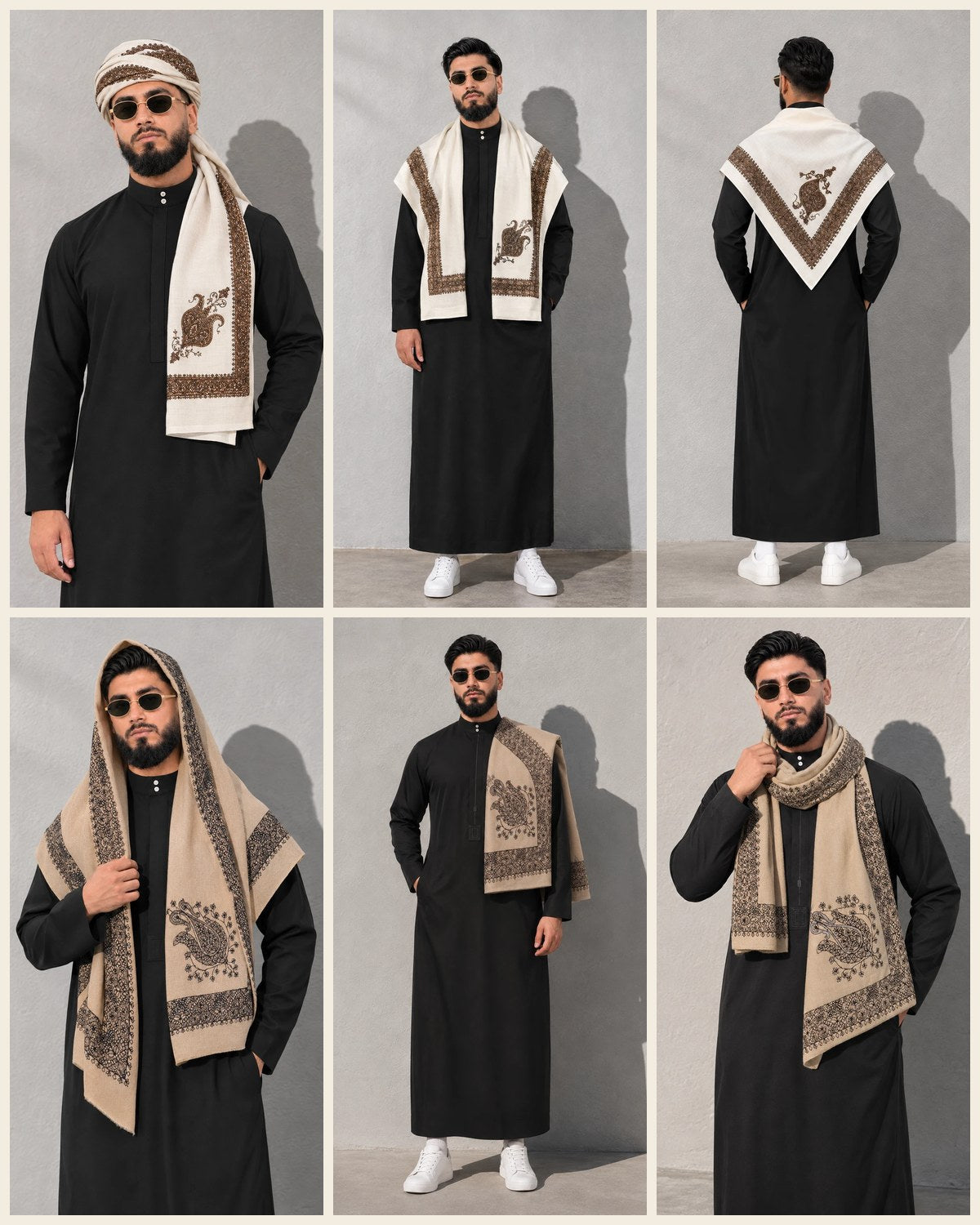
A Yemeni shemagh is a 52" × 52" embroidered square, and that one square can be worn at least six ways: wrapped as a turban, draped open over both shoulders, folded into a triangle on the back, pulled over the head like a hood, thrown over one shoulder or wrapped around the neck. Below is each style with a photo and simple steps. New to it? Start with what a Yemeni shemagh is.
Quick guide: which style for which day
-
Yemeni turban: Jummah, Eid and any day you want the traditional look.
-
Open shoulder drape: Eid salah, a nikah or a walima. It shows the most embroidery from the front.
-
Triangle on the back: gatherings and evenings, when the corner embroidery is seen from behind.
-
Head drape: sun, wind and cool mornings.
-
Over one shoulder: everyday wear. It takes five seconds.
-
Neck wrap: winter, under a coat.
Before You Start
-
Use a full-size square. Every style here uses a 52" × 52" shemagh. Folded corner to corner, its long edge is about 73 inches, enough for a turban with a tail. A smaller scarf may not go round the head.
-
Find the embroidered corner. Most styles look best with a corner paisley showing at the front or the back.
-
Press out deep creases. Iron on a low to medium setting, from the reverse side, so the folds lie flat.
-
Use a mirror the first few times, especially for the turban.
You don't need an agal, the black cord worn with a Gulf ghutra. Yemeni styles are wrapped or draped, so nothing has to hold them in place.
1. How to Tie a Yemeni Turban

The turban is the classic Yemeni way to wear it: wrapped around the head, with one end left loose as a tail over the shoulder.
-
Fold the shemagh corner to corner into a triangle.
-
Lay the long folded edge across your forehead, just above the eyebrows, with the point at the back of your head.
-
Slide it to one side until one end hangs down to your waist. This is the tail. The other end stays short.
-
Take the short end around the back of your head, over the point, and back to the front. Keep wrapping it round your head, a little higher each time.
-
Tuck the last few inches under the wrapped layers at the side.
-
Tuck the point at the back into the layers so it doesn't hang down.
-
Let the tail fall over your shoulder and down your chest, with the embroidered corner on show.
Tip: make the first wrap firm across the forehead, because that layer holds the rest. Some men wear a kufi underneath so the wrap has something to grip.
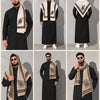
In the photo: the White & Brown Yemeni shemagh over our Artisan Black Saudi thobe.
2. Open Shoulder Drape

The dressiest style, and also the easiest. Both ends hang down the front, so the embroidered border frames your chest.
-
Fold the shemagh in half, then in half again lengthwise, to make a long band about 13 inches wide.
-
Lay the middle of the band behind your neck.
-
Let both ends fall straight down your chest, the same length on each side.
-
Turn the ends so a corner paisley sits at the bottom of one side. Leave it open: there is no knot.
A white or cream shemagh stands out most over a dark thobe. In the photo: the White & Brown.
3. Triangle on the Back

This style is made to be seen from behind: the border forms a V down your back, with the corner paisley at the point.
-
Fold the shemagh corner to corner into a triangle, with the embroidered corners at the point.
-
Hold the two ends of the long folded edge and swing it behind you, so the point hangs down the middle of your back.
-
Bring the ends forward over your shoulders and let them hang down your chest.
-
Centre the point on your spine, so the V is even on both sides.
In the photo: the White & Brown again, so you can compare it with the turban and the drape.
4. Head Drape (Hood Style)

An open drape over the head that frames the face. It keeps off the sun and the wind, and it looks calm and simple.
-
Fold the shemagh in half into a rectangle, so it is double thickness and easier to handle.
-
Place it over your head with the open, embroidered edges at the front, just above your forehead.
-
Let both sides fall past your shoulders and down your chest, the same length on each side.
-
Turn the front edge back a little so the border frames your face, then draw the sides slightly towards your chest.
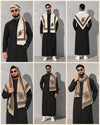
In the photo: the Beige & Charcoal Yemeni shemagh.
5. Over One Shoulder

The quickest style of all, and the one for everyday: over a thobe, a kurta or even a jacket.
-
Fold the shemagh in half, then in half again, into a neat rectangle.
-
Lay it over one shoulder, with a little more length at the front than at the back.
-
Turn it so a corner paisley shows on the front.
It is also the easy way to carry your shemagh indoors: put it over your shoulder instead of folding it into a bag. In the photo: the Beige & Charcoal.
6. Neck Wrap for Winter

For cold Jummahs and Canadian winters: wrapped once at the neck, worn inside or outside your coat.
-
Fold the shemagh in half lengthwise twice, into a long band.
-
Lay it behind your neck with one end longer than the other.
-
Take the long end once around your neck.
-
Let both ends hang down the front and loosen the wrap, so it sits softly rather than tight against your throat.
Under an open coat, tuck the ends inside to keep the wind out. In the photo: the Beige & Charcoal.
Which Yemeni Shemagh Should You Use?
Any of our shemaghs works for all six styles, because every one is the same 52" × 52" square. For your first one, a light ground is easiest: the folds and the border show clearly, like the White & Brown and the Beige & Charcoal in these photos.
To pick a colour and border, read how to choose a Yemeni shemagh, or see which Yemeni shemagh goes with your thobe.
Wearing a checked keffiyeh instead? The folds are similar, and our guide on how to wear a keffiyeh shows five ways, including the desert face wrap.
Ready to Try It?
Start with the shoulder drape, then work up to the turban. Every Yemeni shemagh we sell is 52" × 52" and $35, ships free on orders over $80 to Canada and the USA, has duties included on US orders, and comes with 14-day returns.